
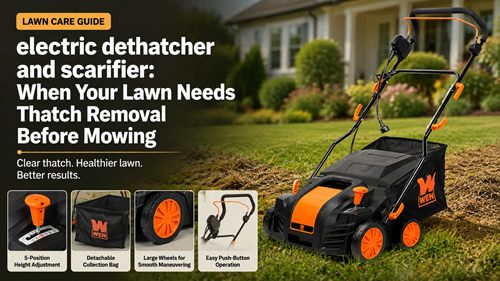
An electric dethatcher and scarifier removes accumulated thatch and can use scarifying tines or blades to disturb the surface more aggressively. It should be used as a renovation tool when the lawn actually has a thatch problem, not as a routine step before every mowing session.
Thatch is the layer of living and dead stems, roots, and organic material between green grass and soil. A thin layer can be normal; excessive buildup can interfere with water, air, and nutrient movement and can make the lawn feel spongy.
For property owners restoring lawns with visible thatch and weak grass growth, the correct approach is to confirm the problem, choose the right season for the grass type, set depth conservatively, and plan recovery before using a powered dethatcher or scarifier.
When An Electric Dethatcher And Scarifier Belongs In Lawn Renovation
Measure the thatch layer by cutting a small wedge of turf and inspecting the brown organic layer above the soil. Do not confuse surface clippings with true thatch.
Dethatching is less aggressive than scarifying in many machines, while scarifier blades may cut deeper into the surface. Start shallow and make a test pass before increasing depth.
Timing matters because the lawn needs active growth to recover. The correct season differs between cool-season and warm-season grasses, so use local extension guidance for your turf type.
Dethatcher And Scarifier Features That Matter
Electric Dethatching
This point changes how the electric dethatcher and scarifier behaves in normal residential use. electric lawn dethatching is a useful internal reference for comparing the feature with an existing product or site guide.
Check the exact model specifications and current manufacturer instructions because configuration details can vary even between similarly named mowers.
Scarifier Depth
This point changes how the electric dethatcher and scarifier behaves in normal residential use. scarifier depth settings is a useful internal reference for comparing the feature with an existing product or site guide.
Check the exact model specifications and current manufacturer instructions because configuration details can vary even between similarly named mowers.
Thatch Removal
This point changes how the electric dethatcher and scarifier behaves in normal residential use. thatch buildup removal is a useful internal reference for comparing the feature with an existing product or site guide.
Check the exact model specifications and current manufacturer instructions because configuration details can vary even between similarly named mowers.
Spring Renovation
This point changes how the electric dethatcher and scarifier behaves in normal residential use. spring lawn renovation tool is a useful internal reference for comparing the feature with an existing product or site guide.
Check the exact model specifications and current manufacturer instructions because configuration details can vary even between similarly named mowers.
Pre-Mowing Preparation
This point changes how the electric dethatcher and scarifier behaves in normal residential use. pre-mowing lawn preparation is a useful internal reference for comparing the feature with an existing product or site guide.
Check the exact model specifications and current manufacturer instructions because configuration details can vary even between similarly named mowers.
Scarifying Limits
This point changes how the electric dethatcher and scarifier behaves in normal residential use. scarifying compacted turf is a useful internal reference for comparing the feature with an existing product or site guide.
Check the exact model specifications and current manufacturer instructions because configuration details can vary even between similarly named mowers.
Dethatching Method By Lawn Condition
Use this comparison as a decision framework and verify exact specifications for the model you are considering.
| Lawn Condition | Likely Approach | Caution |
|---|---|---|
| Thin normal thatch | No powered removal needed | Avoid unnecessary damage |
| Moderate loose buildup | Light dethatching pass | Work in suitable growing season |
| Dense matted thatch | Multiple controlled passes | Do not remove too much at once |
| Compacted soil | Aeration may be more appropriate | Scarifying is not core aeration |
| Bare weak lawn | Diagnose cause before aggressive work | Recovery may require overseeding |
The machine should solve a confirmed problem. A more aggressive setting is not automatically a better renovation.
Prepare The Lawn For Dethatching And Recovery
Mow to an appropriate height before renovation, mark irrigation heads and shallow cables, and remove surface debris. Choose dry grass with soil that is not waterlogged.
- Confirm thatch thickness
- Identify grass type and recovery season
- Mark irrigation and hidden obstacles
- Install the correct tine or scarifier cassette
- Begin at the shallowest useful setting
- Make a straight test pass
- Collect loosened material
- Water, seed, or fertilize only as appropriate afterward
Allow the turf to recover before returning to normal mowing pressure. A lawn can look rough immediately after proper dethatching, so judge success over recovery rather than the same day.
Dethatching And Scarifying Mistakes
- Treating loose clippings as thatch
- Using the deepest setting first
- Working on stressed dormant grass
- Ignoring irrigation heads and shallow obstacles
- Confusing scarifying with soil aeration
- Expecting the lawn to look finished immediately
Aggressive renovation can thin a healthy lawn when the diagnosis or timing is wrong. Confirm the need before powering up the machine.
Tines, Scarifier Blades, And Electrical Care
Inspect tines or blades for bending and wear, clean debris after disconnecting power, and keep extension cords or batteries within the manufacturer’s requirements.
Store cassettes clean and dry so corrosion does not change depth or balance. Check fasteners before seasonal use because dethatching vibration can loosen hardware.
For general walk-behind mower operating precautions, review the U.S. Consumer Product Safety Commission mower safety guidance and follow the exact owner’s manual for the model you use.
Use A Dethatcher When The Lawn Diagnosis Supports It
An electric dethatcher and scarifier is valuable when excessive thatch or surface renovation is confirmed and the timing allows the turf to recover.
Start shallow, protect irrigation and obstacles, remove debris, and support recovery. Routine mowing should resume after the lawn stabilizes rather than immediately after an unnecessarily aggressive pass.
Frequently Asked Questions
Is a electric dethatcher and scarifier suitable for every small residential yard?
No. Yard size is only one factor. Access, slope, grass condition, clipping method, storage, power source, and the operator’s preferred maintenance routine all affect fit.
What should I compare before buying?
Measure the yard, identify the hardest mowing condition, compare cutting height and deck features, then review maintenance, storage, safety controls, and replacement-part availability.
How can I improve cut quality without buying a larger mower?
Keep the blade or cutting line in good condition, mow dry grass at an appropriate height, reduce walking speed in dense growth, and avoid removing too much leaf blade in one pass.
Should I mow wet grass?
It is generally better to wait. Wet grass can reduce traction, clog the deck or catcher, and create a less consistent cut. Follow the owner’s manual and local conditions.
How often does a mower need maintenance?
Follow the model-specific manual by operating hours and calendar intervals. Blade condition, cleaning, fasteners, wheels, power system, and storage all need periodic attention.