
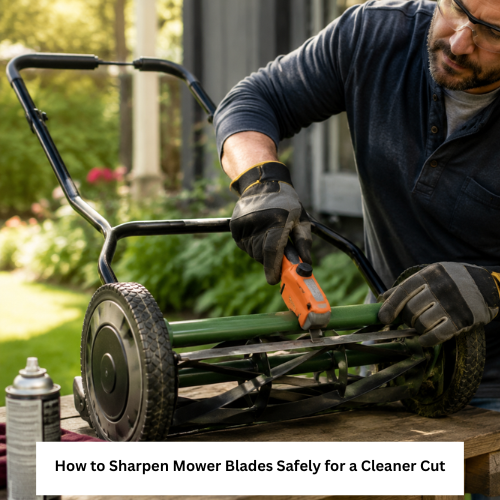
Before you sharpen mower blades, identify whether the mower uses a rotary blade, reel cutting system, or another product-specific design. Rotary mower blades are generally remove and sharpened individually, while reel mowers often require adjustment, backlapping, or specialized servicing.
Blade work involves sharp metal, stored energy, fuel, electricity, and heavy mower components. Disconnect the power source, follow the mower manual, and arrange professional service when the blade remove or secured safely.
When to Sharpen Mower Blades
Common signs that sharpening need include:
- Torn or ragged grass tips
- Uneven cutting
- Repeated mowing over the same area
- Longer mowing time
- Reduced collection or mulching performance
- A visibly rounded cutting edge
- Increased strain during normal cutting
Inspect the blade before deciding to sharpen it. Replacement is usually safer when the blade is crack, bent, deeply chipped, heavily corroded, or worn around its mounting hole.
| Blade condition | Sharpen | Replace | Professional inspection |
| Edge is dull but blade is straight | Often appropriate | Not normally required | Optional |
| Small surface nicks | May be possible | Consider if damage is deep | Useful when uncertain |
| Blade is bent | No | Yes | Recommended |
| Crack is visible | No | Yes | Stop using mower |
| Mounting hole is worn | No | Yes | Check spindle and hardware |
| Blade cannot be balanced | Stop sharpening | Yes | Check mower for other damage |
| Heavy vibration continues | Do not continue mowing | Blade or other part may need replacement | Recommended |
A blade that looks sharp can still be unsafe when it is unbalanced, bent, or installed with incorrect hardware.
Identify the Cutting System First
Rotary mower blade
A rotary blade spins horizontally under the deck. It commonly has one or more cutting edges and may include lifting sections that support bagging or mulching.
A blade push lawn mower may use a rotary cutting blade that requires removal, balancing, and correct reinstallation according to its manual.
Do not replace a rotary blade with one that merely has a similar length. Mounting shape, center hole, outer holes, lift, thickness, rotation, and deck clearance must match.
Reel mower cutting system
A reel mower uses several curved blades that pass a stationary bed knife. The reel and bed knife work like scissors.
A five tempered alloy steel blade mower uses a reel style cutting system, so its sharpening and adjustment method differs from a rotary mower.
A four blade push reel lawn mower should be serviced using reel mower instructions rather than the rotary blade procedure described below.
A StaySharp Max reel push lawn mower may use a specialized cutting system, so verify the manufacturer maintenance process before filing or grinding any edge.
Do not remove or grind reel blades using rotary mower instructions.
Tools and Safety Equipment
The tools required vary by mower and blade design. Common items may include:
- Work gloves that resist cuts
- Eye protection
- Closed shoes
- Correct socket or wrench
- Wooden blade block or approved holding tool
- Marker or tape
- Bench vise with protective jaws
- File, approved sharpener, or suitable grinder
- Blade balancer
- Torque wrench
- Cleaning brush
- Manufacturer-approved replacement hardware
A compatible lawn mower hand sharpener may help you sharpen mower blades with controlled passes, but verify that it is intended for your blade style.
Do not use a damaged file, cracked grinding wheel, loose vise, or improvised blade-holding method.
Prepare the Mower Safely
Move the mower to a firm and level work area with good lighting.
Gas mower preparation
- Turn off the engine.
- Let the engine and muffler cool.
- Disconnect the spark plug wire.
- Close the fuel valve when provided.
- Prevent accidental fuel leakage.
- Tilt the mower only in the direction stated by the manual.
Tilting a gas mower incorrectly can allow fuel or oil to enter the air filter, cylinder, carburetor, or exhaust.
Battery mower preparation
- Remove the battery.
- Remove the safety key.
- Keep the battery away from the work area.
- Confirm the control cannot energize the blade.
Corded mower preparation
- Unplug the mower.
- Keep the plug visible.
- Move the extension cord away from the deck and work area.
Never work under a mower supported only by an unstable object. Use the approved service position or arrange qualified service.
When Blade Replacement Is Better
Choose blade replacement rather than sharpening when:
- The blade is bent
- A crack is present
- The mounting hole is damage
- The blade has lost significant width
- The lift section is worn
- Corrosion has weakened the metal
- Deep impact damage remains
- Balance cannot be restored
- The blade has already reached its service limit
- The manufacturer requires replacement
Verify the part number before buying. Blade length alone does not establish compatibility.
Common Sharpening Mistakes
Avoid:
- Leaving the spark plug, battery, key, or cord connected
- Working under an unstable mower
- Sharpening a cracked or bent blade
- Grinding both sides into a knife edge
- Changing the original bevel
- Removing too much material
- Failing to balance the blade
- Installing the blade upside down
- Reusing damaged hardware
- Guessing the fastener torque
- Applying rotary instructions to a reel mower
- Testing the mower near people or property
Buyers can review an American Lawn Mower blade sharpener listing as an external comparison, then verify compatibility, instructions, package contents, and return terms.
Conclusion
Learning to sharpen mower blades safely involves more than creating a sharp edge. The blade must be suitable for sharpening, removed with the mower fully disabled, kept at its original bevel, balanced, and reinstalled with correct hardware and torque. Buy push lawn mower gives homeowners relevant sharpeners, blade mowers, and reel mower options to compare while keeping safety and compatibility first.
FAQ
How often should mower blades be sharpened?
Inspect the cut and blade regularly. Sharpening frequency depends on mowing hours, grass conditions, and contact with debris.
Can I sharpen a blade without removing it?
Removing a rotary blade normally allows safer inspection, controlled sharpening, and balancing. Follow the mower manual.
How sharp should a mower blade be?
The edge should follow the factory bevel and should not be ground into a fragile razor edge.
Why must a mower blade be balanced?
An unbalanced blade can create vibration, poor cutting, fastener stress, and damage to mower components.
Can reel mower blades be sharpened like rotary blades?
No. Reel systems normally require adjustment, backlapping, or specialized grinding according to the manufacturer.
