
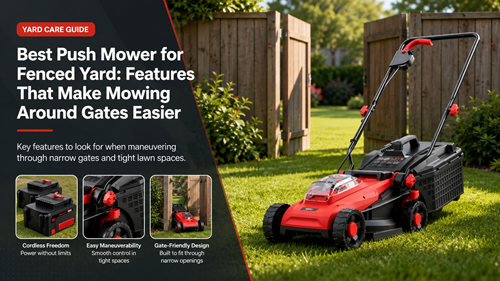
Best Push Mower For Fenced Yard is easiest to choose when the mower is matched to the property instead of being judged by power or deck size alone. A fenced lawn creates two different buying problems: getting the mower through the gate and moving it efficiently once inside. A wide deck may reduce straight-line passes but can lose that advantage if it forces awkward turns near fence lines, raised beds, posts, play equipment, or patios.
This guide is written for homeowners maintaining fenced backyards with limited entry space. The best push mower for fenced yard use should enter the property with realistic clearance and leave enough room for your hands on the handle. It should also let you approach boundaries safely without trying to force the deck under fencing or trim so close that the blade area contacts posts or hidden debris.
For a best push mower for fenced yard, start by measuring and observing the yard before comparing models. Sketch the yard before comparing models. Mark gate width, inside corners, tree rings, fixed furniture, slopes, and storage location. That simple map makes maneuverability a measurable requirement instead of a vague product claim.
How To Choose A Best Push Mower For Fenced Yard
Measure the smallest gate opening, identify the tightest corners inside the fence, and choose a mower that can turn without repeated lifting. For many fenced yards, compact overall width, controllable weight, rear or mulching discharge, and a handle that is easy to pivot matter more than maximum deck size.
The right choice should make the normal weekly route easier, not merely win a specification comparison. Think about turning, transport, clipping handling, blade access, and the conditions that occur when the grass is growing fastest.
A useful buying test is to imagine the first ten minutes of mowing and the last ten minutes of cleanup. If the machine fits both parts of that routine, it is much more likely to remain a practical long-term purchase.
Gate, Turning, And Boundary Features To Compare
Mower For Gated Backyard
Gate width is the first hard limit. Compare the mower’s complete fixed width and any removable or folding components, and leave enough clearance to roll through without tilting a running machine.
For a practical comparison, review mower for gated backyard and compare the dimensions or operating limits with your own yard.
Maneuverable Lawn Mower
Maneuverability comes from wheelbase, weight distribution, handle leverage, and drive behavior. A model that turns easily at walking speed can save more effort than a slightly wider mower that needs constant backing.
When you narrow the shortlist, compare maneuverable lawn mower against the route, grass condition, and storage limits you measured.
Mower For Fence Edges
Fence edges still require a safe margin. Deck overhang and wheel placement affect how close the blade path reaches, but a string trimmer is often the better tool for the last narrow strip next to posts.
A useful specification check is mower for fence edges while confirming that the exact model still matches the manufacturer instructions.
Compact Mower For Enclosed Lawn
Enclosed lawns may have few long runs. Compact machines can be efficient when the yard consists of short lanes, small islands of turf, and several corners rather than one open rectangle.
For this part of the decision, use compact mower for enclosed lawn as a reference point rather than assuming one feature guarantees overall performance.
Easy Turning Lawn Mower
Front-wheel-drive or light push designs can feel different during tight turns. If possible, test how the mower pivots with the bag attached and at the intended cutting height.
Before ordering, cross-check easy turning lawn mower and focus on the specific characteristic discussed here, not the marketing headline alone.
Backyard Mowing Machine
Backyard access also includes ramps, steps, gravel, and storage doors. Choose a machine that can be moved safely through the complete route before and after mowing.
To connect the feature with a real mower or guide, review backyard mowing machine before deciding whether that feature is worth paying for on your property.
Quick Comparison Table
Use this table to turn the topic into a shortlist. The “best” column is not a universal specification; it describes the direction that generally fits the condition in the first column.
| Situation | What to Prioritize | What to Watch |
|---|---|---|
| Gate opening | Measure hard opening at narrowest point | Allow several inches of practical clearance |
| Turns | Short wheelbase and balanced weight help | Avoid constant lifting to redirect |
| Fence edge | Use controlled deck approach | Finish close trim with separate tool |
| Bagging | Rear bag keeps side profile compact | Full bag increases rear weight |
| Drive | Choose controllable assist if needed | Too much drive can complicate tight turns |
A Practical Buying and Mowing Checklist
Use the checklist before purchase and again before the first mowing session. It keeps the decision grounded in yard measurements, safe operation, and maintenance rather than a single headline feature.
- Measure the smallest gate opening
- Map every inside corner
- Check mower width with chute attached
- Compare wheelbase and overall weight
- Inspect rear-bag clearance
- Plan safe fence-edge trimming
- Confirm handle control reach
- Measure garage or shed door too
A closely related planning step is covered in narrow-side-yard mower sizing, which can help you compare another part of the same mowing workflow without repeating this article’s focus.
Mistakes That Cost Time or Cut Quality
- Assuming the gate label equals usable opening
- Buying the widest deck that fits on paper
- Trying to mow flush against fence posts
- Ignoring turning space around landscaping
Most of these mistakes come from optimizing one mower specification while ignoring the property. Measure first, use the manual’s operating limits, and make small adjustments after observing the first few mowing sessions.
Safety, Maintenance, and Ownership
Routine ownership still matters after the purchase. Keep the blade sharp, clean the deck with the power source disabled, inspect wheels and fasteners, and follow the manual for battery, cord, fuel, oil, and seasonal storage requirements.
Before every mow, inspect the area for stones, wire, toys, sticks, holes, people, and pets. Wear appropriate footwear and eye protection, keep guards in place, and never clear a chute or touch the blade area until the mower is fully disabled according to its manual.
For an authoritative safety or turf reference, review CPSC walk-behind mower guidance and apply it together with the instructions supplied for the exact mower model.
Final Buying Direction
A best push mower for fenced yard should solve the property-specific problem described in this guide without creating new issues with access, cut quality, maintenance, or storage. The most useful specifications are the ones you can connect directly to a measurement or mowing condition in your own yard.
Shortlist two or three models, compare the complete mower footprint and approved operating features, verify blade and replacement-part support, and choose the machine that makes a safe repeatable weekly routine simplest.
Frequently Asked Questions
What mower size works best for a fenced backyard?
The right size depends on the narrowest gate and the amount of open turf. Compact 14- to 18-inch decks can be easier in constrained layouts, while larger decks suit wide gates and open runs.
Should the mower be narrower than the gate?
Yes. Practical clearance is important for wheels, your hands, steering corrections, and any bag or chute hardware.
Is self-propelled useful in a fenced yard?
It can help on slopes or larger lawns, but the drive should be easy to disengage or modulate for tight corners.
How do I mow along a fence safely?
Keep the deck away from posts and hidden debris, mow parallel where practical, and use a separate trimming tool for the final edge.
Does rear bagging help in an enclosed lawn?
Rear bagging keeps the side profile narrower than some side-discharge setups, but the bag adds length and weight as it fills.