
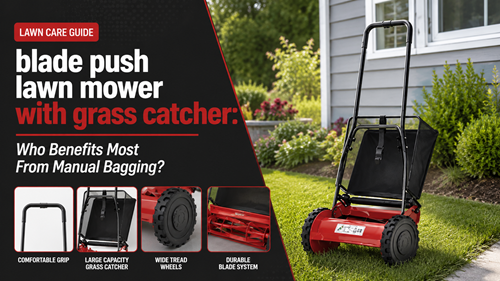
A blade push lawn mower with grass catcher combines manual reel cutting with a catcher so homeowners can collect clippings without gasoline, charging, or a powered drive. The idea is attractive for small maintained lawns, but catcher capacity, reel sharpness, grass height, and walking pace determine whether the setup feels efficient.
Manual reels cut best when grass is maintained regularly and the reel-to-bedknife adjustment is correct. Tall stems, seed heads, twigs, and uneven ground can reduce cutting consistency long before the catcher becomes the limiting factor.
For eco-conscious homeowners who want manual mowing without leaving loose clippings, the real question is whether clipping collection is important enough to accept the extra weight and frequent emptying of a small manual catcher.
Who Benefits From A Blade Push Lawn Mower With Grass Catcher
This format suits short regular mowing sessions better than neglected tall grass. If you often miss weekly mowing during rapid growth, a manual reel may require multiple passes or a different tool.
The catcher is most helpful along patios, sidewalks, pools, or areas where loose clippings are inconvenient. On an ordinary healthy lawn, leaving finely cut clippings may be simpler.
Because the mower has no powered airflow, the catcher relies on reel motion and forward speed. Very light or damp material may not enter the bag as completely as with a rotary bagging mower.
Manual Bagging Features That Matter
Manual Catcher Design
This point changes how the blade push lawn mower with grass catcher behaves in normal residential use. manual mower clipping catcher is a useful internal reference for comparing the feature with an existing product or site guide.
Check the exact model specifications and current manufacturer instructions because configuration details can vary even between similarly named mowers.
Reel Collection
This point changes how the blade push lawn mower with grass catcher behaves in normal residential use. reel blade grass collection is a useful internal reference for comparing the feature with an existing product or site guide.
Check the exact model specifications and current manufacturer instructions because configuration details can vary even between similarly named mowers.
Fuel-Free Bagging
This point changes how the blade push lawn mower with grass catcher behaves in normal residential use. bagging without gasoline is a useful internal reference for comparing the feature with an existing product or site guide.
Check the exact model specifications and current manufacturer instructions because configuration details can vary even between similarly named mowers.
Quiet Cleanup
This point changes how the blade push lawn mower with grass catcher behaves in normal residential use. quiet clipping cleanup is a useful internal reference for comparing the feature with an existing product or site guide.
Check the exact model specifications and current manufacturer instructions because configuration details can vary even between similarly named mowers.
Catcher Fit
This point changes how the blade push lawn mower with grass catcher behaves in normal residential use. manual mower catcher fit is a useful internal reference for comparing the feature with an existing product or site guide.
Check the exact model specifications and current manufacturer instructions because configuration details can vary even between similarly named mowers.
Lower-Input Lawn Care
This point changes how the blade push lawn mower with grass catcher behaves in normal residential use. eco-friendly lawn bagging is a useful internal reference for comparing the feature with an existing product or site guide.
Check the exact model specifications and current manufacturer instructions because configuration details can vary even between similarly named mowers.
Manual Catcher Fit By Lawn Condition
Use this comparison as a decision framework and verify exact specifications for the model you are considering.
| Condition | Expected Result | Better Approach If Needed |
|---|---|---|
| Short dry turf | Clean reel cut and manageable collection | Continue frequent mowing |
| Tall grass | Missed stems and fuller catcher | Raise cut or use rotary mower |
| Uneven ground | Inconsistent reel contact | Choose larger wheels or different mower |
| Leafy surface | Partial pickup | Rake or use powered bagging |
| Tight urban lawn | Excellent maneuverability | Confirm catcher clears obstacles |
A manual catcher is a convenience feature on the right lawn, not a vacuum system for every kind of debris.
Get Better Results From Manual Bagging
Keep the reel sharp and properly adjusted, mow before the grass becomes too tall, and use a steady walking pace. Remove sticks and stones because a reel can jam on hard debris.
- Inspect reel and bedknife contact
- Set height for the grass type
- Attach the catcher securely
- Mow when grass is dry
- Use overlapping straight passes
- Empty the catcher before it drags
- Brush clippings from the reel after use
- Store dry to reduce corrosion
If the mower starts tearing rather than cutting, stop and inspect reel adjustment and sharpness. Pushing harder does not fix poor blade contact.
Manual Reel And Catcher Mistakes
- Waiting until the lawn is overgrown
- Expecting powered vacuum-style pickup
- Allowing the catcher to drag when overfilled
- Using a dull or poorly adjusted reel
- Mowing sticks and hard debris
- Choosing a reel mower for very rough terrain
The manual system is efficient because it is simple. It works best when the lawn routine is equally consistent.
Reel Adjustment, Cleaning, And Storage
Clean and dry the reel, bedknife, wheels, and catcher after use. Follow the manual for reel adjustment and sharpening or backlapping procedures.
A manual mower has fewer engine or battery expenses, but cutting performance still depends on mechanical alignment. Occasional adjustment is part of ownership, not a sign that the mower is defective.
For general walk-behind mower operating precautions, review the U.S. Consumer Product Safety Commission mower safety guidance and follow the exact owner’s manual for the model you use.
Use Manual Bagging For Small Maintained Lawns
A blade push lawn mower with grass catcher is most useful for homeowners who value quiet mowing and clipping collection on a lawn that is already kept short.
Prioritize reel condition, catcher fit, height range, and yard smoothness. If grass is frequently tall or the surface is rough, a rotary or powered mower may be the more practical choice.
Frequently Asked Questions
Is a blade push lawn mower with grass catcher suitable for every small residential yard?
No. Yard size is only one factor. Access, slope, grass condition, clipping method, storage, power source, and the operator’s preferred maintenance routine all affect fit.
What should I compare before buying?
Measure the yard, identify the hardest mowing condition, compare cutting height and deck features, then review maintenance, storage, safety controls, and replacement-part availability.
How can I improve cut quality without buying a larger mower?
Keep the blade or cutting line in good condition, mow dry grass at an appropriate height, reduce walking speed in dense growth, and avoid removing too much leaf blade in one pass.
Should I mow wet grass?
It is generally better to wait. Wet grass can reduce traction, clog the deck or catcher, and create a less consistent cut. Follow the owner’s manual and local conditions.
How often does a mower need maintenance?
Follow the model-specific manual by operating hours and calendar intervals. Blade condition, cleaning, fasteners, wheels, power system, and storage all need periodic attention.