
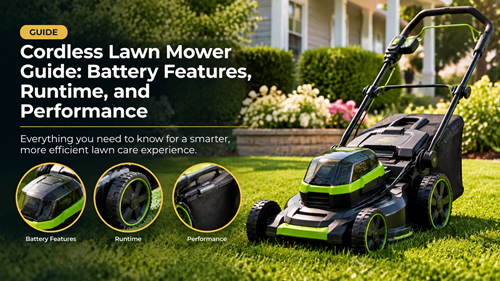
A cordless lawn mower guide should translate battery specifications into a mowing plan. Voltage, amp-hours, watt-hours, motor design, blade load, deck width, self-propel use, grass density, and temperature all affect how much yard can be cut before the battery needs to recharge.
The most useful question is not “how many minutes does it run?” but “can the battery system finish my normal lawn with reserve?” Reserve matters because grass grows faster after rain, blades dull, batteries age, and drive systems use energy.
This guide explains the features that change real runtime and helps buyers compare a cordless mower as part of a battery platform rather than as a single tool.
How A Cordless Lawn Mower Guide Converts Battery Specs Into Yard Fit
Voltage describes electrical potential, while amp-hours describe charge capacity. Multiplying them gives a rough watt-hour figure that is more useful for comparing stored energy, but it still does not predict runtime perfectly because mower efficiency and load vary.
A wider deck can reduce passes but may require more power to keep blade speed under load. Self-propelled drive also consumes battery energy, especially on slopes or at higher speeds.
Battery temperature matters during charging and storage. Packs that are too hot or cold may charge slowly or be temporarily refused by the charger, so the storage location can affect convenience as much as the nominal runtime.
Cordless Lawn Mower Guide Battery Features That Matter
Stored Energy
Look beyond voltage and compare battery capacity, included pack count, and whether the mower uses one or multiple packs.
A battery powered mower is easier to plan around when the included energy is clearly stated and replacement packs are readily available.
Battery Chemistry And Protection
Modern outdoor power equipment commonly uses lithium-ion packs with integrated electronics that monitor voltage, current, and temperature.
Treat each lithium ion mower battery as part of a matched charging system rather than substituting unapproved packs or chargers.
Recharge Strategy
Fast charging can reduce downtime, but charging speed, battery temperature, and charger availability should be considered together.
A rechargeable lawn mower works best when the recharge window fits your mowing routine rather than forcing a mid-lawn pause.
Cord-Free Routing
Without a power cord, the operator can mow around trees, beds, and detached areas without planning outlet locations.
The value of wireless lawn equipment increases when several tools share compatible packs and chargers.
Noise And Neighborhood Fit
Electric motors are generally quieter than gasoline engines, though the blade and airflow still create substantial sound.
A quiet lawn mower can improve scheduling flexibility, but local noise rules and courtesy still matter.
Battery Platform Expansion
A mower purchase can determine which trimmers, blowers, and other tools are easiest to add later.
Compare electric yard tools by battery compatibility before committing to a platform that may be expensive to expand.
Runtime Factors And Their Likely Effect
Use these factors to add reserve to a runtime estimate.
| Condition | Runtime Effect | Planning Response |
|---|---|---|
| Short dry grass | Lower load | Normal reserve |
| Tall dense grass | Higher load | Raise deck and slow pace |
| Self-propel on slopes | Higher load | Plan extra battery capacity |
| Bagging heavy clippings | Moderate to high load | Empty bag and keep airflow clear |
| Cool or hot battery | Charging may be limited | Follow temperature guidance |
| Older battery | Capacity can decline | Budget for replacement |
If the lawn only fits the advertised runtime with no margin, the battery system is undersized for reliable weekly use.
Estimate Runtime Before Buying
Time your current mowing route or estimate it by sections, then add reserve for heavy growth and interruptions. Compare that requirement with the capacity of the included battery set.
- Measure mowable area
- Time a normal mowing route
- Note slopes and thick zones
- Check included battery count
- Compare watt-hours where available
- Check charger time
- Price a replacement battery
- Confirm storage temperature range
A second battery can be more useful than a faster charger when the yard regularly exceeds one pack, but only if the mower can swap packs quickly and the platform cost makes sense.
Battery Buying Mistakes That Create Downtime
- Comparing voltage without capacity
- Using advertised runtime as a guarantee
- Ignoring self-propel energy use
- Buying into a platform with scarce replacement packs
- Charging a hot battery immediately when the manual says to cool it
- Storing packs in extreme heat
Battery convenience depends on the complete ecosystem: mower efficiency, pack capacity, charger, replacement availability, and storage habits.
Battery Safety And Long-Term Performance
Inspect packs and chargers for damage, keep terminals clean and dry, and use only combinations approved by the manufacturer. Stop using a battery that is swollen, cracked, overheating abnormally, or otherwise damaged.
Keep the mower deck clean and the blade sharp because excess mechanical load wastes battery energy. Store the mower and packs according to the manual rather than leaving lithium-ion batteries in extreme temperatures.
For general lithium-ion charging principles, the CPSC recommends using manufacturer-approved batteries and chargers and following charging instructions; see its battery charging safety guidance and the mower manufacturer’s manual.
Buy Enough Battery Reserve For Real Grass
A cordless lawn mower guide is useful when it converts battery numbers into a yard-specific energy plan. Capacity, motor efficiency, cutting load, self-propel use, charging time, and battery availability all shape the real experience.
Choose enough reserve that an unusually heavy mowing day does not turn into an unfinished lawn. That margin makes cordless ownership feel simple rather than restrictive.
Frequently Asked Questions
What battery specification matters most?
No single number is enough. Compare voltage, amp-hours or watt-hours, included pack count, mower efficiency, and the load created by your yard.
Should I buy a second mower battery?
It can be useful when one pack cannot finish the lawn with reserve or when the battery also powers other tools.
Does a brushless motor increase runtime?
Brushless designs can improve efficiency and reduce wear in many tools, but total runtime still depends on the complete mower and cutting load.
Can I charge a lawn mower battery in a garage?
Follow the manufacturer’s temperature, ventilation, charger, and supervision instructions. Avoid damaged packs and unapproved chargers.
Why does runtime drop in tall grass?
The motor must supply more torque to maintain blade speed, so it draws more energy from the battery.