
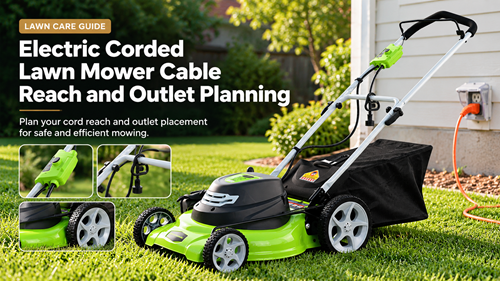
An Electric Corded Lawn Mower offers continuous power without fuel or charging, but the extension cord becomes part of the mowing system. Outlet position, cord length, wire gauge, ground-fault protection, and mowing direction determine whether the setup is practical.
Measure the farthest mowing point from a suitable outdoor outlet, then confirm the mower manual’s extension-cord gauge and maximum length. Plan a route that keeps the cable behind you and away from the blade path, and never substitute an undersized indoor cord.
This guide focuses on cable reach, outlet planning, and the setup details that make corded mowing manageable.
How To Evaluate Electric Corded Lawn Mower
Electric Corded Lawn Mower should be evaluated around the work it must do every week, not around one headline number. Measure the lawn, identify narrow access points and obstacles, note the grass condition, and decide how clippings, charging or fuel, cleaning, and storage will be handled before comparing models.
For an example of the electric corded lawn mower features, use the linked product page to compare the feature set with the requirements of your own yard rather than treating the listing as a universal recommendation.
A broader electric corded lawn mower buying guide, can help separate category-level decisions from product-specific details, especially when several mower types could serve the same residential lawn.
Electric Corded Lawn Mower Features That Matter In Real Use
Outlet Location
A centrally useful outlet reduces cord length and voltage drop. Outdoor circuits should have the protection required by local electrical codes and the mower manual. This is worth checking on the exact model because a small design difference can change handling, cut consistency, or the amount of work required between mowing sessions.
Cord Gauge And Length
Longer cords generally need heavier conductors to carry current safely. Use the exact AWG and length guidance provided by the mower manufacturer. This is worth checking on the exact model because a small design difference can change handling, cut consistency, or the amount of work required between mowing sessions.
Cable Routing
Start near the outlet and mow away from the cord so the cable remains on the already-cut side. Avoid crossing driveways, pools, sharp edges, or areas where people may trip. This is worth checking on the exact model because a small design difference can change handling, cut consistency, or the amount of work required between mowing sessions.
When the shortlist is down to a few models, review the exact electric corded lawn mower specifications. Dimensions, capacity, adjustment ranges, included accessories, and power-system details should come from the current manufacturer or product record.
Specifications And Yard Fit
Weather And Moisture
Corded equipment must not be used when wet conditions or the manual make electrical operation unsafe. Keep plugs and connections dry and protected. Check how that feature interacts with the rest of the mower instead of assuming that a larger, faster, or heavier specification is automatically better.
Storage
Coil the extension cord loosely after inspection and store it dry. Tight kinks, crushed insulation, or hot connectors are signs that the cord needs attention. Check how that feature interacts with the rest of the mower instead of assuming that a larger, faster, or heavier specification is automatically better.
| Yard Situation | Priority | Why It Matters |
|---|---|---|
| Small rectangular lawn | Simple cord route | Good corded fit |
| Multiple fenced sections | More cable handling | Plan outlet access |
| Long narrow lot | Voltage-drop concern | Check gauge and maximum length |
| Wet climate | Operating restrictions | Wait for safe dry conditions |
| Shared walkway | Trip hazard | Keep cord away from traffic |
Setup, Maintenance, And Ownership
Build ownership cost into the decision by checking electric corded lawn mower maintenance. Routine cleaning, blade or line care, battery or engine service, wheel inspection, and seasonal storage all affect how reliably the equipment performs after the first month.
Before the first mowing session, follow a safe electric corded lawn mower setup. Read the owner’s manual, inspect the work area, set the machine on stable ground, and keep hands and feet away from the cutting system whenever power could be available.
Pre-Mowing Ownership Checklist
- Measure outlet-to-farthest-point distance
- Confirm outdoor-rated cord specification
- Inspect plugs and insulation
- Plan the cord-safe mowing direction
- Test the safety handle and switch
- Keep connections dry
- Coil and store the cord after use
Keep the owner’s manual, model number, battery or engine details, and replacement-part information together. That small record makes future maintenance and parts ordering much easier and reduces the risk of using an incompatible blade, battery, line, oil, or accessory.
A Practical Comparison Checklist
For homeowners deciding whether this format genuinely fits the property, use electric corded lawn mower for home lawns. Compare the recommendation with lawn area, access, slopes, obstacles, grass type, and the time available for each mowing session.
A useful final cross-check is a electric corded lawn mower comparison. Compare only the specifications that affect your own yard, then eliminate models that miss a non-negotiable requirement such as access width, cutting height, runtime, storage, or safe operating range.
After narrowing the list, compare total ownership rather than purchase price alone. Replacement blades or line, batteries, chargers, fuel, oil, filters, collection bags, extension cords, and storage accessories can change long-term cost and convenience.
Common Buying Mistakes
- Using an indoor extension cord outdoors
- Choosing cord length without checking wire gauge
- Mowing back toward a cord lying in the cutting path
- Continuing with nicked insulation or a loose plug
- Using the mower in wet conditions against the manual
Avoid solving these problems by forcing the mower to work outside its intended conditions. A safer buying decision starts with the property and mowing routine, then chooses equipment whose published limits comfortably cover that work.
Plan Cord Reach Before Choosing A Corded Lawn Mower
An Electric Corded Lawn Mower makes sense when outlets, extension-cord routing, lawn size, and obstacles allow the machine to reach the full mowing area safely. Constant power can simplify runtime planning, but cord management becomes part of every mowing pass.
Measure the farthest mowing point from a suitable outlet, verify the manufacturer’s extension-cord requirements, and plan a route that keeps the cable behind the mower and away from the blade. Choose the mower only after the electrical setup and property layout work together without improvised reach.
Frequently Asked Questions
How long can an extension cord be for a corded mower?
Use the maximum length and minimum wire gauge specified in the mower manual. Longer runs can increase voltage drop and heating.
Can I use any outdoor extension cord?
No. The cord must meet the mower’s current, gauge, grounding, connector, and outdoor-use requirements.
Where should the cord be while mowing?
Plan the route so the cable stays on the already-cut side and behind the operator, away from the cutting deck.
Can a corded mower be used on wet grass?
Do not use it when conditions or the manual make electrical operation unsafe. Wait for safe dry conditions.
Is a corded mower practical for a large yard?
It can become inconvenient when outlets are distant or the lawn has many obstacles. Measure the route before buying.