
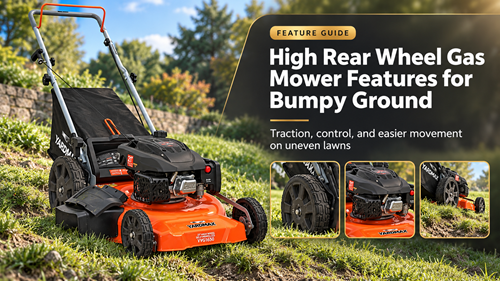
A High Rear Wheel Gas Mower can roll more smoothly over shallow ruts, roots, and uneven lawn transitions than a small-wheel design. Large rear wheels do not make a residential mower all-terrain, so slope, footing, deck clearance, and ground condition still matter.
Compare rear-wheel diameter, wheel construction, height adjustment, deck clearance, handle leverage, engine and fuel routine, and terrain limits in the manual. Large wheels are most useful when they improve rolling without making the mower awkward around gates, beds, or tight obstacles.
This guide focuses on traction, rolling behavior, and the handling details that matter on bumpy residential lawns.
How To Evaluate High Rear Wheel Gas Mower
High Rear Wheel Gas Mower should be evaluated around the work it must do every week, not around one headline number. Measure the lawn, identify narrow access points and obstacles, note the grass condition, and decide how clippings, charging or fuel, cleaning, and storage will be handled before comparing models.
For an example of the high rear wheel gas mower features, use the linked product page to compare the feature set with the requirements of your own yard rather than treating the listing as a universal recommendation.
A broader high rear wheel gas mower buying guide, can help separate category-level decisions from product-specific details, especially when several mower types could serve the same residential lawn.
High Rear Wheel Gas Mower Features That Matter In Real Use
Rear Wheel Diameter
Larger wheels can bridge shallow depressions and roll over minor surface changes more smoothly. Tire width and material also affect traction and turf marking. This is worth checking on the exact model because a small design difference can change handling, cut consistency, or the amount of work required between mowing sessions.
Wheel Mounts And Bearings
A large wheel with loose bushings can wobble and change cutting height. Check axle hardware, bearing service, and replacement wheel availability. This is worth checking on the exact model because a small design difference can change handling, cut consistency, or the amount of work required between mowing sessions.
Deck Clearance
Uneven ground increases the risk of scalping high spots. A useful height range and rigid deck help maintain blade clearance as the chassis moves. This is worth checking on the exact model because a small design difference can change handling, cut consistency, or the amount of work required between mowing sessions.
When the shortlist is down to a few models, review the exact high rear wheel gas mower specifications. Dimensions, capacity, adjustment ranges, included accessories, and power-system details should come from the current manufacturer or product record.
Specifications And Yard Fit
Handle Leverage
High rear wheels can change how the mower pivots. A comfortable handle and balanced deck reduce the effort needed to lift the front slightly for turns. Check how that feature interacts with the rest of the mower instead of assuming that a larger, faster, or heavier specification is automatically better.
Terrain Limits
Roots, holes, steep slopes, rocks, and wet soil can exceed what any residential mower should cross. Repair hazardous ruts and follow slope restrictions. Check how that feature interacts with the rest of the mower instead of assuming that a larger, faster, or heavier specification is automatically better.
| Yard Situation | Priority | Why It Matters |
|---|---|---|
| Shallow ruts | Large rear wheels help | Improved rollover |
| Exposed roots | Use caution | Blade/deck impact risk |
| Soft wet ground | Wait for drying | Avoid rutting and loss of traction |
| Tight landscaping | Check pivot effort | Large wheels add bulk |
| Moderate uneven turf | Height range matters | Reduce scalping |
Setup, Maintenance, And Ownership
Build ownership cost into the decision by checking high rear wheel gas mower maintenance. Routine cleaning, blade or line care, battery or engine service, wheel inspection, and seasonal storage all affect how reliably the equipment performs after the first month.
Before the first mowing session, follow a safe high rear wheel gas mower setup. Read the owner’s manual, inspect the work area, set the machine on stable ground, and keep hands and feet away from the cutting system whenever power could be available.
Pre-Mowing Ownership Checklist
- Walk the yard and mark hazards
- Measure slope and rough areas
- Inspect wheel bearings and axles
- Choose a conservative cutting height
- Test turns on flat ground
- Avoid wet or unstable soil
- Check blade and deck after any impact
Keep the owner’s manual, model number, battery or engine details, and replacement-part information together. That small record makes future maintenance and parts ordering much easier and reduces the risk of using an incompatible blade, battery, line, oil, or accessory.
A Practical Comparison Checklist
For homeowners deciding whether this format genuinely fits the property, use high rear wheel gas mower for home lawns. Compare the recommendation with lawn area, access, slopes, obstacles, grass type, and the time available for each mowing session.
A useful final cross-check is a high rear wheel gas mower comparison. Compare only the specifications that affect your own yard, then eliminate models that miss a non-negotiable requirement such as access width, cutting height, runtime, storage, or safe operating range.
After narrowing the list, compare total ownership rather than purchase price alone. Replacement blades or line, batteries, chargers, fuel, oil, filters, collection bags, extension cords, and storage accessories can change long-term cost and convenience.
Common Buying Mistakes
- Assuming large wheels make steep slopes safe
- Mowing over holes or roots that should be repaired first
- Ignoring wheel wobble or worn axle hardware
- Setting the deck too low on uneven ground
- Using high wheel size as a substitute for traction and footing
Avoid solving these problems by forcing the mower to work outside its intended conditions. A safer buying decision starts with the property and mowing routine, then chooses equipment whose published limits comfortably cover that work.
Choose High Rear Wheels For The Terrain, Not The Label
A High Rear Wheel Gas Mower can make uneven ground easier to cross when larger rear wheels improve rollover and help the deck stay more settled over shallow ruts or bumps. Wheel size does not create traction by itself, and it cannot compensate for poor footing, excessive slope, or an unsuitable mowing route.
Compare rear-wheel diameter with mower weight, front-wheel size, deck clearance, handle leverage, drive system if present, and the manufacturer’s slope guidance. The right setup is the one that gives controlled movement on the actual terrain without encouraging the operator to work beyond safe conditions.
Frequently Asked Questions
Do high rear wheels improve traction?
They can help the mower roll over uneven surfaces, but traction also depends on tread, soil, slope, weight distribution, and whether the mower is self-propelled.
Are high-wheel mowers better on hills?
Not automatically. Slope safety is governed by the mower design and manual. Large wheels do not make unsafe slopes acceptable.
Can large rear wheels prevent scalping?
They may smooth chassis movement, but deck height, wheel position, ground contours, and operator technique still affect scalping.
How should I maintain large mower wheels?
Keep axles clean, check fasteners and bushings or bearings, and replace worn or cracked wheels according to the manual.
What should I do about deep ruts before mowing?
Repair or avoid them rather than forcing the mower through. Deep holes can destabilize the mower or cause deck and blade contact.