
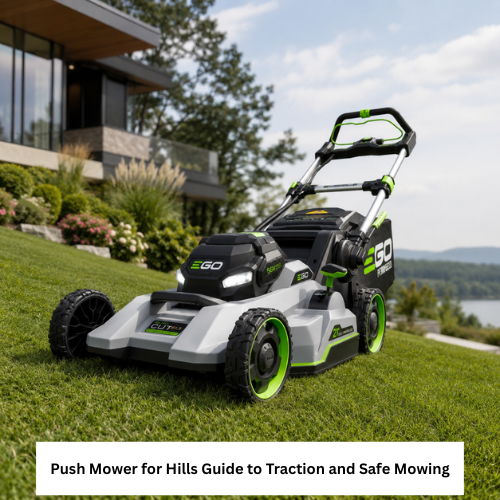
A push mower for hills must provide stable handling, predictable speed, suitable wheel traction, and controls the operator can reach without changing grip. A mower that feels manageable on level ground may become difficult to control on a slope.
Before buying, inspect the yard and identify steep areas, holes, roots, wet ground, drop offs, and narrow turning points. Buy Push Lawn Mower readers should follow the exact slope warnings in the mower manual rather than assuming every walk behind model is suitable.
How to Choose a Push Mower for Hills
A self propelled mower can reduce the effort needed to move uphill, but its speed and drive response must remain comfortable. Wheel size alone does not guarantee safe lawn mower traction.
| Feature | Possible benefit | Main limitation | What to verify |
| Self propelled drive | Reduces uphill pushing effort | May pull too quickly | Speed control and drive release |
| High rear wheels | May roll over uneven ground more easily | Does not create powered traction | Wheel material and axle strength |
| Rear wheel drive | Can provide useful drive force | Handling varies by model | Drive layout and slope guidance |
| Lightweight mower | Easier to turn and reposition | May feel less planted on rough ground | Balance and deck construction |
| Variable speed | Matches different walking speeds | More controls to learn | Control range and response |
The gas mower with high rear wheels may interest buyers comparing wheel size and uneven ground handling. Verify whether it is manually pushed or self propelled and check the slope instructions.
The Worx Nitro self propelled lawn mower provides a cordless option to compare for drive control, battery setup, mower weight, and cutting height adjustment.
A cordless self propelled lawn mower may reduce pushing effort without requiring gasoline. Confirm battery capacity, charger inclusion, drive speed, and expected operating conditions.
The PowerSmart self propelled lawn mower offers another powered drive format. Verify the drive wheel location, speed controls, starting procedure, maintenance schedule, and included grass handling parts.
The Craftsman high wheeled self propelled mower listing provides an external reference for comparing wheel design, drive layout, adjustment controls, and current package information.
Traction Weight and Drive Control
The correct push mower for hills should move at a pace the operator can control. Test the drive engagement and release on level ground before approaching a slope.
A heavier mower may feel stable but can be harder to stop, turn, or move without drive assistance. A lightweight mower may be easier to reposition but still requires suitable tires and balanced handling.
Self propelled vs push mower comparisons should include operator strength, slope length, grass condition, wheel grip, and whether the drive stays engaged during turns.
Hill Mowing Safety
Do not mow when the slope is wet, muddy, icy, or covered with loose debris. Wear footwear with dependable grip and keep children, pets, and bystanders away.
Many walk behind mower instructions advise traveling across slopes rather than directly up and down, but the exact manual must take priority. Never mow a slope that exceeds the manufacturer guidance or feels unsafe.
Maintain secure footing and avoid pulling a running mower toward your feet. Stay away from retaining walls, drainage edges, ponds, and sudden drop offs.
Setup Troubleshooting and Maintenance
Adjust the handle and deck on level ground. Test the blade control, drive lever, speed selector, and emergency release before mowing.
If the drive slips, pulls unevenly, or fails to release, stop using the mower until belts, cables, wheels, and controls are inspected. Do not compensate by forcing the machine across the slope.
Clean packed grass from the deck and wheels only after disabling the mower as directed. Inspect tire tread, wheel fasteners, drive cables, blade condition, and guards regularly.
Hill Mower Buying Checklist
Before buying a push mower for hills check the following points.
- Review the manufacturer slope guidance
- Compare mower weight balance and handle fit
- Confirm drive type speed control and wheel traction
- Check guards blade controls and drive release
- Inspect wheel size tread axle and deck construction
- Review setup testing and safe turning procedures
- Confirm cleaning drive maintenance and storage
- Check warranty and authorized service support
- Review return policy before adding fuel or using outdoors
- Confirm belts wheels batteries blades and cables are available
- Review delivery condition and assembly contents
- Verify before buying when slope suitability is unclear
Conclusion
The safest push mower for hills is not simply the model with the largest wheels or strongest motor. It should match the operator, slope conditions, traction needs, drive control, maintenance ability, and manufacturer guidance.
FAQ
Is a Self Propelled Mower Better for Hills?
It can reduce pushing effort, but buyers must still check drive control, traction, weight, and slope guidance.
Are High Rear Wheels Enough for a Steep Yard?
No. High wheels may help with uneven ground but do not confirm safe slope performance.
Should I Mow Wet Grass on a Hill?
No. Wet grass can reduce traction and make slips or loss of mower control more likely.
Is Rear Wheel Drive Always Best?
Not always. Performance depends on the mower design, grass condition, slope, speed control, and operator.
What Should I Do if the Drive Stops Working?
Stop mowing on the slope and inspect or service the mower before using it again.
