
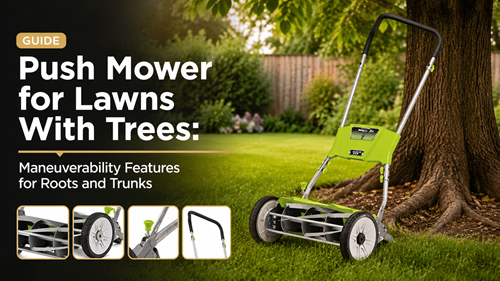
Push Mower For Lawns With Trees is easiest to choose when the mower is matched to the property instead of being judged by power or deck size alone. Trees break a lawn into short curved passes and create exposed roots, shade-thinned turf, sticks, seed pods, and low branches. A mower that is excellent in an open rectangle may feel clumsy when every pass requires a turn.
This guide is written for homeowners mowing landscaped yards with multiple trees and obstacles. A push mower for lawns with trees should be easy to slow, redirect, and back away from obstacles. Self-propelled drive can reduce effort, but only when it can be disengaged or modulated smoothly near trunks.
For a push mower for lawns with trees, start by measuring and observing the yard before comparing models. Inspect the route before starting. Remove fallen branches, mark raised roots, and avoid mowing over irrigation heads or landscape lights hidden by shade.
How To Choose A Push Mower For Lawns With Trees
For lawns with many trees, prioritize maneuverability, predictable wheel placement, moderate deck width, and enough cutting-height range to clear surface roots. The mower should turn around trunks without scraping bark and let you finish close areas with a trimmer rather than forcing the deck into the root flare.
The right choice should make the normal weekly route easier, not merely win a specification comparison. Think about turning, transport, clipping handling, blade access, and the conditions that occur when the grass is growing fastest.
A useful buying test is to imagine the first ten minutes of mowing and the last ten minutes of cleanup. If the machine fits both parts of that routine, it is much more likely to remain a practical long-term purchase.
Maneuverability Features For Roots, Trunks, And Shade
Mower Around Tree Trunks
A light, well-balanced mower is easier to arc around trunks without striking bark. Keep the deck and wheels clear of the root flare and finish the closest strip by another method.
For a practical comparison, review mower around tree trunks and compare the dimensions or operating limits with your own yard.
Lawn Mower For Exposed Roots
Exposed roots can lift one side of the deck abruptly. Use a higher setting and mow around rather than over roots that could contact the blade.
When you narrow the shortlist, compare lawn mower for exposed roots against the route, grass condition, and storage limits you measured.
Turning Mower Under Trees
Front-wheel behavior affects turning. Some drive systems pivot easily when weight is shifted, while others are better suited to straight runs; test the control style before buying.
A useful specification check is turning mower under trees while confirming that the exact model still matches the manufacturer instructions.
Obstacle Friendly Lawn Mower
Obstacle-friendly designs keep controls, wheels, and deck edges easy to judge from the operator position. Compact decks trade pass width for more precise placement.
For this part of the decision, use obstacle friendly lawn mower as a reference point rather than assuming one feature guarantees overall performance.
Shaded Yard Mowing Equipment
Shade can produce thinner, softer turf that needs less aggressive mowing than sunny areas. Avoid using a mower purchase to compensate for grass that is struggling from insufficient light.
Before ordering, cross-check shaded yard mowing equipment and focus on the specific characteristic discussed here, not the marketing headline alone.
Tree Filled Backyard Mower
A tree-filled backyard benefits from a machine that bags or mulches small normal clippings but is not used as a chipper for sticks, nuts, or woody debris. Clear hazards first.
To connect the feature with a real mower or guide, review tree filled backyard mower before deciding whether that feature is worth paying for on your property.
Quick Comparison Table
Use this table to turn the topic into a shortlist. The “best” column is not a universal specification; it describes the direction that generally fits the condition in the first column.
| Situation | What to Prioritize | What to Watch |
|---|---|---|
| Tree trunks | Use wider arcs and trim separately | Do not scrape bark |
| Surface roots | Raise deck and route around | Never strike roots with blade |
| Low branches | Plan path before mowing | Do not duck into unsafe visibility |
| Shade-thin turf | Mow gently at suitable height | Avoid scalping sparse grass |
| Fallen debris | Remove by hand first | Do not rely on deck to process sticks |
A Practical Buying and Mowing Checklist
Use the checklist before purchase and again before the first mowing session. It keeps the decision grounded in yard measurements, safe operation, and maintenance rather than a single headline feature.
- Walk the lawn before mowing
- Remove sticks and hard debris
- Mark major roots
- Set a protective deck height
- Use slow controlled turns
- Keep deck away from bark
- Trim close areas separately
- Inspect blade after any impact
A closely related planning step is covered in heavy-growth recovery planning, which can help you compare another part of the same mowing workflow without repeating this article’s focus.
Mistakes That Cost Time or Cut Quality
- Mowing directly over exposed roots
- Using the mower to shred sticks
- Turning so tightly that wheels scrape trunks
- Lowering the deck because shaded grass is sparse
Most of these mistakes come from optimizing one mower specification while ignoring the property. Measure first, use the manual’s operating limits, and make small adjustments after observing the first few mowing sessions.
Safety, Maintenance, and Ownership
Routine ownership still matters after the purchase. Keep the blade sharp, clean the deck with the power source disabled, inspect wheels and fasteners, and follow the manual for battery, cord, fuel, oil, and seasonal storage requirements.
Before every mow, inspect the area for stones, wire, toys, sticks, holes, people, and pets. Wear appropriate footwear and eye protection, keep guards in place, and never clear a chute or touch the blade area until the mower is fully disabled according to its manual.
For an authoritative safety or turf reference, review CPSC walk-behind mower safety guidance and apply it together with the instructions supplied for the exact mower model.
Final Buying Direction
A push mower for lawns with trees should solve the property-specific problem described in this guide without creating new issues with access, cut quality, maintenance, or storage. The most useful specifications are the ones you can connect directly to a measurement or mowing condition in your own yard.
Shortlist two or three models, compare the complete mower footprint and approved operating features, verify blade and replacement-part support, and choose the machine that makes a safe repeatable weekly routine simplest.
Frequently Asked Questions
What deck size works around many trees?
A moderate or compact deck is often easier to place around trunks, but the ideal size depends on tree spacing and the amount of open turf.
Can I mow over small tree roots?
Avoid blade contact with any exposed root. Route around raised roots and use a separate trimming method nearby.
Is self-propelled drive useful around trees?
It can reduce effort, but choose a system that is easy to slow or disengage for close maneuvering.
Why is grass thin under my trees?
Shade, root competition, moisture, and soil conditions may limit turf. Mowing lower usually does not solve the underlying problem.
Should I mulch small leaves under trees?
Fine dry leaves can often be mulched when the lawn remains visible, but remove sticks, nuts, and heavy leaf accumulations first.