
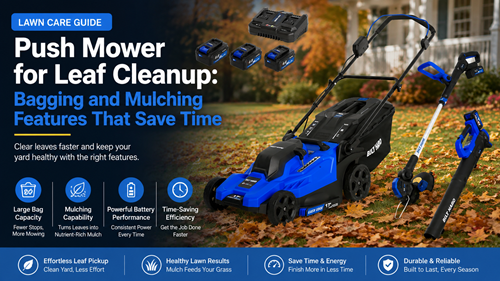
Push Mower For Leaf Cleanup is easiest to choose when the mower is matched to the property instead of being judged by power or deck size alone. Leaves change mower behavior because they are light, bulky, and easy to blow ahead of the deck. Dry leaves mulch efficiently, while wet matted leaves can clog the deck and bag chute and should often be allowed to dry before processing.
This guide is written for homeowners who want to combine mowing with seasonal leaf cleanup. A push mower for leaf cleanup can reduce raking when the blade and deck repeatedly chop a light leaf layer into small pieces. Thick piles are better spread out first so the mower does not lose blade speed or leave windrows.
For a push mower for leaf cleanup, start by measuring and observing the yard before comparing models. Bag capacity matters less than usable filling. A large bag that clogs at the chute may need attention more often than a smaller bag with smooth airflow and an easy emptying shape.
How To Choose A Push Mower For Leaf Cleanup
For fall cleanup, look for strong mulching performance, a bag that fills efficiently without constant clogging, simple mode changes, and enough deck airflow to move dry leaves. The best setup depends on whether you want to return chopped leaves to the lawn or collect them for removal.
The right choice should make the normal weekly route easier, not merely win a specification comparison. Think about turning, transport, clipping handling, blade access, and the conditions that occur when the grass is growing fastest.
A useful buying test is to imagine the first ten minutes of mowing and the last ten minutes of cleanup. If the machine fits both parts of that routine, it is much more likely to remain a practical long-term purchase.
Mulching, Bagging, And Airflow Features For Fall
Mower For Autumn Leaves
Extension guidance supports mulching a manageable layer of leaves into the lawn. Make multiple passes if necessary and stop when chopped material is no longer disappearing between grass blades.
For a practical comparison, review mower for autumn leaves and compare the dimensions or operating limits with your own yard.
Leaf Mulching Mower
A mulching-oriented deck recirculates leaves long enough to reduce particle size. Keep the underside clean because buildup disrupts the airflow that makes repeated chopping work.
When you narrow the shortlist, compare leaf mulching mower against the route, grass condition, and storage limits you measured.
Mower Bag Capacity
Bag capacity should be judged by how often you can fill and empty without stopping to clear the chute. Look at handle position and whether the bag lifts out cleanly.
A useful specification check is mower bag capacity while confirming that the exact model still matches the manufacturer instructions.
Lawn Leaf Collection Equipment
Collection equipment such as rear bags and deflectors should attach securely and match the mower. Never operate with guards defeated to improve leaf flow.
For this part of the decision, use lawn leaf collection equipment as a reference point rather than assuming one feature guarantees overall performance.
Fall Yard Cleanup Mower
A fall cleanup mower may share the workload with a blower for beds, fences, and corners. Move leaves onto mowable turf in thin layers rather than building one deep pile.
Before ordering, cross-check fall yard cleanup mower and focus on the specific characteristic discussed here, not the marketing headline alone.
Mower Suction Performance
Suction performance is affected by blade condition, deck cleanliness, travel speed, and leaf moisture. A sharp correct blade and dry material usually matter more than a vague high-suction claim.
To connect the feature with a real mower or guide, review mower suction performance before deciding whether that feature is worth paying for on your property.
Quick Comparison Table
Use this table to turn the topic into a shortlist. The “best” column is not a universal specification; it describes the direction that generally fits the condition in the first column.
| Situation | What to Prioritize | What to Watch |
|---|---|---|
| Light dry leaves | Mulch in place | Make overlapping passes |
| Moderate leaf layer | Mulch or bag | Slow down if deck loads |
| Deep piles | Spread before mowing | Do not force dense pile under deck |
| Wet leaves | Wait for drying where possible | Clogging risk increases |
| Bagging | Empty before chute blocks | Do not overpack bag |
A Practical Buying and Mowing Checklist
Use the checklist before purchase and again before the first mowing session. It keeps the decision grounded in yard measurements, safe operation, and maintenance rather than a single headline feature.
- Remove branches and stones first
- Wait for leaves to dry
- Sharpen the blade
- Start with a thin layer
- Overlap passes
- Watch for clumping
- Empty bag before airflow drops
- Clean the deck after use
A closely related planning step is covered in clean-pass mowing technique, which can help you compare another part of the same mowing workflow without repeating this article’s focus.
Mistakes That Cost Time or Cut Quality
- Running over hidden sticks in leaf piles
- Trying to process a deep wet pile in one pass
- Using a clogged bag chute
- Assuming leaf cleanup requires bagging every leaf
Most of these mistakes come from optimizing one mower specification while ignoring the property. Measure first, use the manual’s operating limits, and make small adjustments after observing the first few mowing sessions.
Safety, Maintenance, and Ownership
Heavy material makes deck cleaning especially important. Disable the mower fully before clearing any obstruction, wait for all moving parts to stop, and use the manufacturer-approved method rather than reaching into the discharge path.
Before every mow, inspect the area for stones, wire, toys, sticks, holes, people, and pets. Wear appropriate footwear and eye protection, keep guards in place, and never clear a chute or touch the blade area until the mower is fully disabled according to its manual.
For an authoritative safety or turf reference, review CPSC mower safety information for debris hazards and apply it together with the instructions supplied for the exact mower model.
Final Buying Direction
A push mower for leaf cleanup should solve the property-specific problem described in this guide without creating new issues with access, cut quality, maintenance, or storage. The most useful specifications are the ones you can connect directly to a measurement or mowing condition in your own yard.
Shortlist two or three models, compare the complete mower footprint and approved operating features, verify blade and replacement-part support, and choose the machine that makes a safe repeatable weekly routine simplest.
Frequently Asked Questions
Can I mulch leaves with a regular push mower?
Many mowers can mulch a light dry leaf layer when equipped and used according to the manual. Several passes may be needed.
When should I bag leaves instead?
Bagging is useful when leaf volume is too high to disappear into the turf, when debris is mixed in, or when local conditions make mulching impractical.
Why does my mower push leaves instead of picking them up?
Leaves may be too deep or wet, the deck may be dirty, the blade may be dull, or travel speed may be too fast.
Can mulched leaves harm grass?
A heavy intact layer can smother turf, but finely chopped leaves distributed into the canopy can be beneficial when the lawn remains visible.
Should I lower the deck for leaf pickup?
Use a height that protects the turf and mower. Lower is not automatically better, especially where leaves hide bumps and debris.