
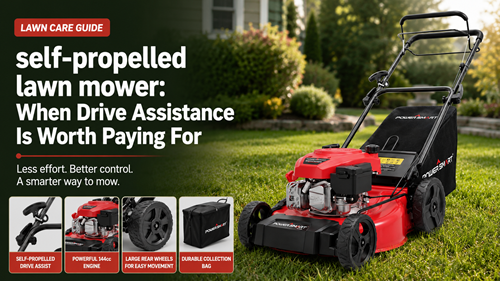
A self-propelled lawn mower adds a powered drive system so the operator guides rather than supplies all forward motion. That assistance can be valuable on slopes, larger residential lawns, thick grass, or any route where repeated pushing creates fatigue.
Drive assistance also adds cost, weight, controls, belts or gearing, and maintenance. A flat compact lawn may not justify those tradeoffs if a light push mower already moves comfortably.
For homeowners with slopes or larger lawns who want less physical pushing effort, the decision should focus on terrain, total mowing time, traction, speed control, turning effort, and whether the drive system remains predictable around trees, beds, gates, and slopes.
When A Self-Propelled Lawn Mower Is Worth The Upgrade
Estimate the longest continuous push and the steepest section of the property. If fatigue changes your mowing pace or makes control worse near the end, drive assistance can improve consistency.
Front-wheel drive can be easy to pivot on flat lawns, while rear-wheel or all-wheel systems may provide better traction in some uneven or sloped conditions. The best layout depends on the route and surface.
Variable speed is more useful than maximum speed. You should be able to slow down around obstacles and dense growth without fighting the transmission.
Drive And Traction Features To Compare
Drive Assistance
This point changes how the self-propelled lawn mower behaves in normal residential use. drive-assisted mower benefits is a useful internal reference for comparing the feature with an existing product or site guide.
Check the exact model specifications and current manufacturer instructions because configuration details can vary even between similarly named mowers.
Slope Handling
This point changes how the self-propelled lawn mower behaves in normal residential use. mowing sloped residential yards is a useful internal reference for comparing the feature with an existing product or site guide.
Check the exact model specifications and current manufacturer instructions because configuration details can vary even between similarly named mowers.
Wheel Traction
This point changes how the self-propelled lawn mower behaves in normal residential use. rear wheel mower traction is a useful internal reference for comparing the feature with an existing product or site guide.
Check the exact model specifications and current manufacturer instructions because configuration details can vary even between similarly named mowers.
Speed Control
This point changes how the self-propelled lawn mower behaves in normal residential use. self-propelled speed control is a useful internal reference for comparing the feature with an existing product or site guide.
Check the exact model specifications and current manufacturer instructions because configuration details can vary even between similarly named mowers.
Pushing Effort
This point changes how the self-propelled lawn mower behaves in normal residential use. reduced pushing effort is a useful internal reference for comparing the feature with an existing product or site guide.
Check the exact model specifications and current manufacturer instructions because configuration details can vary even between similarly named mowers.
Drive-System Layout
This point changes how the self-propelled lawn mower behaves in normal residential use. walk-behind mower drive system is a useful internal reference for comparing the feature with an existing product or site guide.
Check the exact model specifications and current manufacturer instructions because configuration details can vary even between similarly named mowers.
Drive Assistance By Yard Type
Use this comparison as a decision framework and verify exact specifications for the model you are considering.
| Yard Type | Potential Benefit | Watch For |
|---|---|---|
| Flat small lawn | Limited need for assistance | Extra weight and cost |
| Long suburban route | Reduced pushing fatigue | Battery or fuel use |
| Sloped yard | More consistent forward motion | Traction and safe cross-slope control |
| Many trees | Helpful between open sections | Turning resistance |
| Wet or soft ground | Drive may help movement | Avoid mowing unsafe wet slopes |
Do not choose a drive layout by marketing name alone. How the mower responds at walking speed is more important than its theoretical traction advantage.
Test Drive Assistance Before Committing
If possible, test engagement from a stop, slow walking speed, moderate speed, turning, and release. The mower should stop driving predictably when the control is released.
- Measure slope and mowing distance
- Check drive-control reach
- Test the slowest useful speed
- Practice turns without forcing the drive
- Keep tires clean for traction
- Release drive before tight repositioning
- Inspect cables or controls regularly
- Follow transmission service guidance
Use the drive to maintain control, not to pull the mower through grass that is too tall for the chosen cutting height. Raise the deck or reduce the cutting load instead.
Self-Propelled Mower Buying Mistakes
- Choosing top speed instead of controllability
- Assuming every drive system climbs the same
- Ignoring added machine weight when drive is off
- Using drive power to force an overloaded deck
- Overlooking replacement drive parts
- Mowing unsafe wet slopes because traction feels strong
The powered wheels help movement; they do not change the limits of the blade, deck, slope safety, or operator visibility.
Drive System Maintenance And Long-Term Cost
Keep wheels free of packed debris and inspect drive cables, belts, gears, and engagement controls as the manual specifies. Reduced drive performance may be a maintenance issue rather than an engine or motor problem.
When comparing price, include batteries for cordless models or long-term transmission and belt service for gas models. The upgrade is worthwhile when it consistently saves effort over the full ownership period.
For general walk-behind mower operating precautions, review the U.S. Consumer Product Safety Commission mower safety guidance and follow the exact owner’s manual for the model you use.
Pay For Drive Assistance When It Solves A Repeated Problem
A self-propelled lawn mower earns its premium on properties where slopes, distance, or heavy mowing make manual pushing a recurring burden.
Choose smooth controllable assistance, suitable traction, and manageable turning. A predictable mower at your normal walking pace is more useful than a faster system you constantly disengage.
Frequently Asked Questions
Is a self-propelled lawn mower suitable for every small residential yard?
No. Yard size is only one factor. Access, slope, grass condition, clipping method, storage, power source, and the operator’s preferred maintenance routine all affect fit.
What should I compare before buying?
Measure the yard, identify the hardest mowing condition, compare cutting height and deck features, then review maintenance, storage, safety controls, and replacement-part availability.
How can I improve cut quality without buying a larger mower?
Keep the blade or cutting line in good condition, mow dry grass at an appropriate height, reduce walking speed in dense growth, and avoid removing too much leaf blade in one pass.
Should I mow wet grass?
It is generally better to wait. Wet grass can reduce traction, clog the deck or catcher, and create a less consistent cut. Follow the owner’s manual and local conditions.
How often does a mower need maintenance?
Follow the model-specific manual by operating hours and calendar intervals. Blade condition, cleaning, fasteners, wheels, power system, and storage all need periodic attention.