
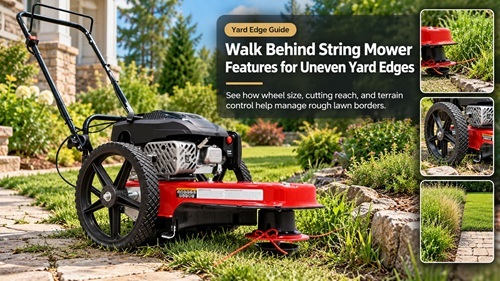
A Walk Behind String Mower fills the gap between a handheld trimmer and a conventional mower. Large wheels and flexible cutting line can handle rough edges, fence lines, drainage areas, and tall vegetation where a rigid mower deck may be inconvenient.
Compare cutting swath, approved line diameter, wheel height, handle adjustment, engine or motor type, debris guarding, replacement-line access, and terrain limits in the manual. It is best treated as a rough-cut tool rather than a direct finish-mower replacement.
This guide explains which features matter most when uneven edges and rough ground drive the purchase.
How To Evaluate Walk Behind String Mower
Walk Behind String Mower should be evaluated around the work it must do every week, not around one headline number. Measure the lawn, identify narrow access points and obstacles, note the grass condition, and decide how clippings, charging or fuel, cleaning, and storage will be handled before comparing models.
For an example of the walk behind string mower features, use the linked product page to compare the feature set with the requirements of your own yard rather than treating the listing as a universal recommendation.
A broader walk behind string mower buying guide, can help separate category-level decisions from product-specific details, especially when several mower types could serve the same residential lawn.
Walk Behind String Mower Features That Matter In Real Use
Cutting Line System
Thicker line can handle coarse weeds but increases load and may not suit every head. Use only the diameter and shape approved for the model. This is worth checking on the exact model because a small design difference can change handling, cut consistency, or the amount of work required between mowing sessions.
Wheel Size And Ground Following
Large rear wheels can roll over ruts and vegetation, but stability still depends on slope, soil firmness, and operator control. Check slope limitations in the manual. This is worth checking on the exact model because a small design difference can change handling, cut consistency, or the amount of work required between mowing sessions.
Cutting Swath
A wide swath clears broad edges efficiently, yet it also throws debris across a larger area. Maintain a generous safety zone around windows, vehicles, and people. This is worth checking on the exact model because a small design difference can change handling, cut consistency, or the amount of work required between mowing sessions.
When the shortlist is down to a few models, review the exact walk behind string mower specifications. Dimensions, capacity, adjustment ranges, included accessories, and power-system details should come from the current manufacturer or product record.
Specifications And Yard Fit
Engine And Starting
Gas models require fuel, oil, air-filter, and spark-plug care. Electric versions shift attention to batteries or cords, but all types need line and guard inspection. Check how that feature interacts with the rest of the mower instead of assuming that a larger, faster, or heavier specification is automatically better.
Edge Versus Finish Quality
Flexible line is useful around rough vegetation but does not create the same flat, uniform finish as a sharp mower blade. Use each tool for the surface it handles best. Check how that feature interacts with the rest of the mower instead of assuming that a larger, faster, or heavier specification is automatically better.
| Yard Situation | Priority | Why It Matters |
|---|---|---|
| Fence-line weeds | Strong match | Flexible line reaches irregular edge |
| Rough drainage strip | Potentially useful | Check slope and footing |
| Smooth front lawn | Conventional mower better | More uniform finish |
| Tall coarse growth | Useful with approved line | Work in gradual passes |
| Loose gravel | High debris risk | Avoid throwing stones |
Setup, Maintenance, And Ownership
Build ownership cost into the decision by checking walk behind string mower maintenance. Routine cleaning, blade or line care, battery or engine service, wheel inspection, and seasonal storage all affect how reliably the equipment performs after the first month.
Before the first mowing session, follow a safe walk behind string mower setup. Read the owner’s manual, inspect the work area, set the machine on stable ground, and keep hands and feet away from the cutting system whenever power could be available.
Pre-Mowing Ownership Checklist
- Walk the area and remove debris
- Mark rocks, posts, and irrigation heads
- Confirm approved line size
- Inspect guards and wheels
- Plan a direction that throws debris safely
- Use gradual passes in tall growth
- Clean the head and deck after use
Keep the owner’s manual, model number, battery or engine details, and replacement-part information together. That small record makes future maintenance and parts ordering much easier and reduces the risk of using an incompatible blade, battery, line, oil, or accessory.
A Practical Comparison Checklist
For homeowners deciding whether this format genuinely fits the property, use walk behind string mower for home lawns. Compare the recommendation with lawn area, access, slopes, obstacles, grass type, and the time available for each mowing session.
A useful final cross-check is a walk behind string mower comparison. Compare only the specifications that affect your own yard, then eliminate models that miss a non-negotiable requirement such as access width, cutting height, runtime, storage, or safe operating range.
After narrowing the list, compare total ownership rather than purchase price alone. Replacement blades or line, batteries, chargers, fuel, oil, filters, collection bags, extension cords, and storage accessories can change long-term cost and convenience.
Common Buying Mistakes
- Using line thicker than the manufacturer allows
- Working near gravel, glass, or hard debris without clearing it
- Treating the machine like a finish mower on a manicured lawn
- Operating across slopes beyond the manual’s limits
- Replacing line without fully stopping and disabling the machine
Avoid solving these problems by forcing the mower to work outside its intended conditions. A safer buying decision starts with the property and mowing routine, then chooses equipment whose published limits comfortably cover that work.
Choose A Walk Behind String Mower For Rough Edge Work
A Walk Behind String Mower is most useful where tall weeds, rough boundaries, fence lines, or uneven ground make a conventional mower awkward. Its value comes from access and cutting flexibility, not from replacing a finish mower on every part of the property.
Compare line size, replacement access, wheel diameter, cutting height, engine or power requirements, handle control, and the terrain it is designed to cross. The right machine should simplify the difficult edge work while leaving normal lawn mowing to the tool that gives the cleaner routine cut.
Frequently Asked Questions
What is a walk-behind string mower best for?
It is useful for tall weeds, rough edges, fence lines, and uneven areas where flexible line and larger wheels are advantageous.
Can it replace a regular lawn mower?
Not always. A conventional mower normally gives a more uniform finish on maintained turf, while a string mower is better for rough-cut work.
What line diameter should I use?
Use only the diameter and material approved by the manufacturer. Oversized line can overload or damage the head.
Is a walk-behind string mower safe on slopes?
Only within the slope and operating limits in the manual. Uneven footing and rollover or loss-of-control risks still apply.
How often should the line be replaced?
Replace it when worn, shortened, damaged, or unable to maintain the intended cutting width, following the model’s loading procedure.