
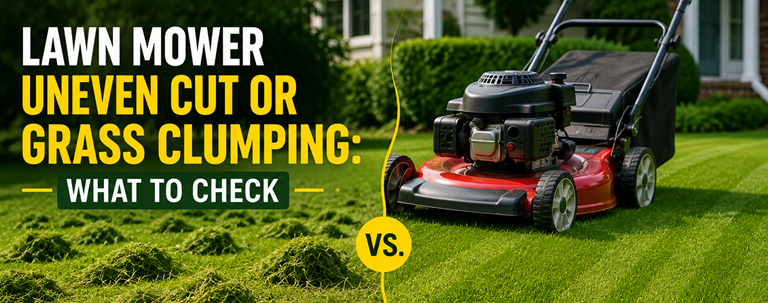
Direct Answer: Lawn Mower Uneven Cut or Grass Clumping: What to Check
The core answer on Lawn Mower Uneven Cut or Grass Clumping: What to Check is grounded in the current guide: Use uneven mower cut as a practical comparison point for the mower, the job, and the space you manage. Lawn Mower Uneven Cut or Grass Clumping: What to Check focuses on the practical question behind uneven mower cut clumping.
What Does Cutting Height Clarify For Lawn Mower Uneven Cut or Grass Clumping: What to Check?
The "Cutting Height" part of Lawn Mower Uneven Cut or Grass Clumping: What to Check states that Confirm that all height-adjustment points are set as designed and that the deck is not accidentally lower on one side.
How Does Dull or Damaged Blade Affect A Decision Using Lawn Mower Uneven Cut or Grass Clumping: What to Check?
Lawn Mower Uneven Cut or Grass Clumping: What to Check uses "Dull or Damaged Blade" to clarify that A dull rotary blade can tear grass, while damage or imbalance can affect cut quality and vibration.
What Must Stay Model-Specific When Using Lawn Mower Uneven Cut or Grass Clumping: What to Check?
Lawn Mower Uneven Cut or Grass Clumping: What to Check should not be used to transfer one model's specifications to another; exact limits, fit, included components and performance claims belong to the specific product record or manufacturer documentation.
Use uneven mower cut as a practical comparison point for the mower, the job, and the space you manage. Lawn Mower Uneven Cut or Grass Clumping: What to Check focuses on the practical question behind uneven mower cut clumping. It is written for owners unhappy with cut quality who need to separate what can be verified from what still depends on the exact mower or manual.
Cut quality improves fastest when the symptom is matched to a physical cause instead of answered by repeatedly lowering the mower.
Cutting Height
Confirm that all height-adjustment points are set as designed and that the deck is not accidentally lower on one side. Another useful cross-check is the lawn mower troubleshooting guide.
On overgrown grass, raising the first cut can also reduce load and clump formation. For the next detailed comparison, see the lawn mower cutting systems guide. For a closely related detail, use the mowing overgrown grass.
Dull or Damaged Blade
A dull rotary blade can tear grass, while damage or imbalance can affect cut quality and vibration.
Sharpen only a serviceable blade and replace damaged hardware with the correct part.
Wet or Heavy Grass
Wet or dense grass can stick under the deck and overwhelm mulching or bagging flow. Related product example: PowerSmart DB2194S 21″ 3-in-1 161cc Gas Self Propelled Lawn Mower — Buy Now on Amazon.
Waiting for safer, drier conditions and slowing the pace can improve discharge without changing hardware.
Deck Buildup
Accumulated clippings can interfere with airflow and reduce space around the blade. Another useful cross-check is the clean lawn mower deck.
Clean the deck with the power system safely isolated and inspect it for damage at the same time.
Wheel or Deck Adjustment
A damaged wheel, loose axle component or incorrect deck adjustment can change cutting height as the mower travels.
Use the product manual to verify the adjustment mechanism before replacing parts.
Clumping and uneven cut are often connected. Wet grass can build up under the deck, change airflow and leave material that lifts or presses the next pass unevenly. Cleaning and waiting for drier conditions can solve more than one symptom at once.
If one side consistently cuts lower on dry, maintained grass, inspect wheel and deck adjustment rather than compensating by raising or lowering the whole mower.
Uneven Mower Cut
First, use Uneven Mower Cut as a practical comparison point. Next, match the mower to the work you expect. However, avoid one-number shortcuts. Therefore, compare the important details together. Then, confirm the exact model before you decide.
Uneven Mower Cut Compatibility Checks
For example, check size, fit, and operating limits. In addition, review the mower for everyday use. Meanwhile, compare yard conditions, grass height, and mowing frequency. As a result, weak options become easier to remove. Afterward, keep only choices that fit the job.
Uneven Mower Cut Practical Buying Checks
Moreover, inspect the supporting parts before you order. Then, check battery, fuel, cord, blade, or wheel needs as relevant. Because models differ, compare the exact product details. At the same time, note the maintenance work each option needs. Finally, confirm that replacement parts remain easy to source.
First, measure your storage space. Next, check path and gate width. Then, compare mower weight and handle reach. After that, review charging or fuel access. Finally, check cleaning and blade-care needs.
In practice, use these checks together. However, avoid choosing from one headline feature. Instead, compare fit, control, upkeep, and ownership needs. Therefore, keep the final choice practical. Overall, this approach supports a clearer mower decision.
Related product: View Related Uneven Mower Cut Product on Amazon.