
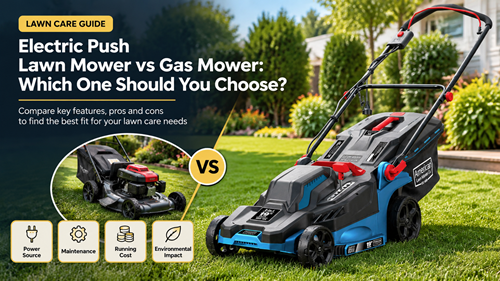
Electric push lawn mower vs gas mower is not a simple contest between modern and traditional power. The better platform depends on mowing time, grass load, charging access, storage, maintenance tolerance, noise expectations, and whether the property demands quick refueling or can work within battery or cord limits.
Electric machines usually start with fewer routine engine-service tasks. Gas machines avoid charging downtime and can be refueled quickly, but they add fuel handling, engine maintenance, noise, and exhaust. The decision becomes clearer when those ownership differences are compared against a real mowing route.
This guide focuses on practical homeowner use rather than maximum specifications, so buyers can estimate which platform will still feel convenient after a full season.
Electric Push Lawn Mower Vs Gas Mower Ownership Differences
The first difference is energy storage. A battery mower carries a finite electrical charge that must be restored, while a gas mower carries fuel that can be replenished quickly. Corded electric models remove battery limits but add route planning around an extension cord.
Maintenance also changes. Electric drive systems eliminate oil changes, spark plugs, carburetor concerns, and fuel stabilization, though blades, wheels, fasteners, cooling passages, batteries, and chargers still need attention.
Noise and local emissions are another dividing line. Electric equipment has no tailpipe exhaust during use and generally produces less operating noise, while small gasoline engines create combustion emissions and require fuel storage.
Electric Push Lawn Mower Vs Gas Mower Factors To Compare
Battery Runtime
Runtime changes with grass height, moisture, blade sharpness, bagging, slope, drive use, battery condition, and temperature.
A battery lawn mower should be evaluated with realistic reserve rather than the best-case runtime printed on a box.
Cordless Convenience
Removing a cord improves route freedom, but it shifts the planning problem to charging and spare-battery availability.
The practical cordless mower benefits are strongest when the battery platform already fits the property and storage space.
Gas Load Handling
Engine torque and refueling speed can be helpful for long sessions, but mower performance still depends on deck airflow, blade condition, and mowing pace.
Compare gas mower performance with the actual grass density and cut height you expect to maintain.
Environmental Tradeoffs
Electric mowers eliminate exhaust at the point of use, while gas engines produce combustion emissions. Electricity generation and battery manufacturing still have environmental impacts.
For homeowners interested in eco friendly lawn care, a reel mower can be another low-noise option for small frequently cut lawns.
Cost Beyond Purchase Price
Include fuel or electricity, oil and filters, replacement batteries, chargers, blades, service, and expected ownership years.
A structured mower comparison keeps the total ownership picture visible instead of comparing purchase price alone.
The Rest Of The Tool System
Battery platforms can share packs across trimmers and blowers, while gas households may already have fuel and engine-service routines.
Browse outdoor power tools with platform compatibility in mind rather than treating the mower as an isolated purchase.
Electric And Gas Mower Comparison
These are general ownership tendencies; exact models can vary significantly.
| Factor | Electric Push Mower | Gas Mower |
|---|---|---|
| Starting | Button, lever, or key sequence | Pull start or electric start depending on model |
| Energy planning | Charge, battery reserve, or cord reach | Fuel level and fresh gasoline |
| Routine engine service | No gasoline engine | Oil/filter/spark-plug/fuel tasks may apply |
| Noise | Generally lower | Generally higher |
| Long continuous use | Limited by battery or cord setup | Fast refueling supports long sessions |
| Storage | No gasoline storage | Fuel ventilation and engine storage matter |
Model-level comparisons still matter. A well-designed battery mower can outperform a weak gas mower in some conditions, and a basic gas mower can be easier to keep running through a long property than an undersized battery setup.
Calculate Your Real Mowing Session
Time one normal mow, note how often the mower works hardest, and record whether you bag, mulch, or discharge. Use that baseline to estimate battery reserve or fuel needs.
- Time a full mowing session
- Measure the farthest point from power
- Identify thick or sloped sections
- Estimate charging access
- List engine maintenance you will perform
- Compare noise restrictions
- Price replacement batteries or engine service
- Check storage ventilation
A real session time is more useful than lawn acreage alone because obstacles, turns, bag emptying, and grass density all change energy use.
Comparison Mistakes That Distort The Decision
- Assuming voltage alone predicts cutting power
- Comparing ideal battery runtime with worst-case gas use
- Ignoring replacement battery cost
- Ignoring gas maintenance time
- Treating every electric mower as quiet enough for any hour
- Assuming gas automatically handles every tall-grass situation
Compare complete mower systems and realistic conditions. Marketing categories are useful starting points, not performance guarantees.
Energy, Maintenance, And Safe Operation
Use only the battery and charger combinations approved for an electric mower, keep packs within manufacturer temperature limits, and inspect them for damage before charging. For gas mowers, use fresh fuel and follow engine storage instructions.
Regardless of power source, stop the mower and disable the power system before clearing the deck or servicing the blade. Keep hands and feet away from the discharge opening and rotating components.
The U.S. EPA notes that gas-powered lawn and garden engines emit pollutants and suggests electric, battery, or manual equipment as lower-emission alternatives; see its lawn and garden equipment pollution guidance for broader environmental context.
Choose The Power System That Fits The Entire Routine
Electric push lawn mower vs gas mower becomes a practical decision when runtime, maintenance, noise, storage, emissions, and mowing load are compared together. Electric can simplify ownership on well-matched properties, while gas can remain convenient for long sessions and quick refueling.
Do not overlook the basics: a sharp blade, correct height, clean deck, and controlled pace influence lawn appearance no matter which power source turns the blade.
Frequently Asked Questions
Are electric lawn mowers powerful enough for thick grass?
Many are capable, but performance depends on the exact mower, blade, battery state, deck design, grass height, and mowing pace. Avoid removing too much growth in one pass.
How long does a battery mower run?
Runtime varies widely with battery capacity and mowing load. Use the manufacturer’s figures as a starting point and keep reserve for heavy sections.
Are gas mowers cheaper to own?
Not always. Compare fuel, oil, filters, service, replacement batteries, chargers, and expected ownership years.
Can an electric mower be used on wet grass?
It is generally better to wait until the lawn is dry enough to mow safely and cleanly. Follow the exact mower manual.
Which mower is easier to store?
Electric mowers avoid gasoline storage, but battery temperature limits and charger space still matter. Gas mowers need safe fuel and engine storage.