
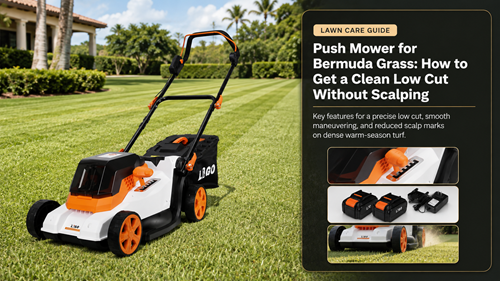
Push Mower For Bermuda Grass is easiest to choose when the mower is matched to the property instead of being judged by power or deck size alone. Bermudagrass has a dense, fine-textured growth habit and is often maintained lower than many cool-season lawns. That makes surface smoothness, blade sharpness, wheel tracking, and height-adjustment precision especially visible in the finished cut.
This guide is written for homeowners maintaining warm season Bermuda grass. A push mower for bermuda grass should move evenly across the lawn without the deck nose-diving into small depressions. Reel mowers can produce a very clean low cut on smooth turf, while rotary mowers are more forgiving where the surface is less level or occasional debris is present.
For a push mower for bermuda grass, start by measuring and observing the yard before comparing models. The key is consistency. Mowing often enough to remove a modest amount of leaf tissue produces a better result than letting the lawn get tall and then trying to return it to a low setting in one session.
How To Choose A Push Mower For Bermuda Grass
Bermudagrass responds best to frequent, consistent mowing with a sharp blade and a mower that can hold the intended low setting without bouncing or scalping. Choose deck and wheel geometry for your lawn smoothness, then reduce height gradually rather than dropping the deck after the grass becomes tall.
The right choice should make the normal weekly route easier, not merely win a specification comparison. Think about turning, transport, clipping handling, blade access, and the conditions that occur when the grass is growing fastest.
A useful buying test is to imagine the first ten minutes of mowing and the last ten minutes of cleanup. If the machine fits both parts of that routine, it is much more likely to remain a practical long-term purchase.
Low-Cut Control Without Scalping
Bermuda Mowing Height
Use local turf recommendations to select height, then confirm the mower can hold that setting consistently. A numbered lever is useful only if the actual height range fits bermudagrass management.
For a practical comparison, review bermuda mowing height and compare the dimensions or operating limits with your own yard.
Mower For Low Cut Grass
Low-cut turf reveals blade quality. Reel systems can produce a scissor-like finish on smooth ground, while a well-maintained rotary blade may be more practical on typical residential surfaces.
When you narrow the shortlist, compare mower for low cut grass against the route, grass condition, and storage limits you measured.
Fine Turf Cutting Mower
Fine turf favors clean cutting and stable forward movement. Check blade sharpness frequently because frayed leaf tips become visible quickly on a dense bermuda surface.
A useful specification check is fine turf cutting mower while confirming that the exact model still matches the manufacturer instructions.
Anti Scalping Mower Setup
Anti-scalping behavior comes from level ground, balanced wheels, sensible deck width, and avoiding sudden dips. Mow across contours carefully rather than trying to force the lowest possible setting.
For this part of the decision, use anti scalping mower setup as a reference point rather than assuming one feature guarantees overall performance.
Bermuda Lawn Maintenance Tools
Bermuda maintenance often includes edging, blade service, and debris removal. Keep the cutting chamber clean so clippings do not build up and disturb airflow.
Before ordering, cross-check bermuda lawn maintenance tools and focus on the specific characteristic discussed here, not the marketing headline alone.
Clean Cut Lawn Equipment
A clean-cut setup is one you can maintain. Easy blade access, accurate height adjustment, and straight wheel tracking matter more over a season than a one-time showroom appearance.
To connect the feature with a real mower or guide, review clean cut lawn equipment before deciding whether that feature is worth paying for on your property.
Quick Comparison Table
Use this table to turn the topic into a shortlist. The “best” column is not a universal specification; it describes the direction that generally fits the condition in the first column.
| Situation | What to Prioritize | What to Watch |
|---|---|---|
| Smooth level lawn | Reel or precise rotary can work | Lowest settings need very flat turf |
| Uneven lawn | Rotary mower is more forgiving | Avoid extreme low height |
| Blade condition | Very sharp edge | Frayed tips show quickly |
| Frequency | Frequent light removal | Do not wait for excessive growth |
| Turns | Lift or widen turns at low height | Sharp pivots can scalp |
A Practical Buying and Mowing Checklist
Use the checklist before purchase and again before the first mowing session. It keeps the decision grounded in yard measurements, safe operation, and maintenance rather than a single headline feature.
- Confirm local bermuda height guidance
- Level obvious high spots if practical
- Inspect blade or reel sharpness
- Start slightly higher after missed mowing
- Use overlapping straight passes
- Avoid tight powered pivots on low turf
- Change direction periodically
- Clean the deck after mowing
A closely related planning step is covered in dense cool-season mower setup, which can help you compare another part of the same mowing workflow without repeating this article’s focus.
Mistakes That Cost Time or Cut Quality
- Dropping directly from tall growth to a very low setting
- Trying to copy golf-turf height on an uneven home lawn
- Using a dull rotary blade
- Pivoting sharply while the deck is low
Most of these mistakes come from optimizing one mower specification while ignoring the property. Measure first, use the manual’s operating limits, and make small adjustments after observing the first few mowing sessions.
Safety, Maintenance, and Ownership
Routine ownership still matters after the purchase. Keep the blade sharp, clean the deck with the power source disabled, inspect wheels and fasteners, and follow the manual for battery, cord, fuel, oil, and seasonal storage requirements.
Before every mow, inspect the area for stones, wire, toys, sticks, holes, people, and pets. Wear appropriate footwear and eye protection, keep guards in place, and never clear a chute or touch the blade area until the mower is fully disabled according to its manual.
For an authoritative safety or turf reference, review University of Florida bermudagrass management guidance and apply it together with the instructions supplied for the exact mower model.
Final Buying Direction
A push mower for bermuda grass should solve the property-specific problem described in this guide without creating new issues with access, cut quality, maintenance, or storage. The most useful specifications are the ones you can connect directly to a measurement or mowing condition in your own yard.
Shortlist two or three models, compare the complete mower footprint and approved operating features, verify blade and replacement-part support, and choose the machine that makes a safe repeatable weekly routine simplest.
Frequently Asked Questions
Is a reel mower best for bermuda grass?
A reel mower can produce an excellent low cut on smooth, level bermuda, but a rotary mower may be more practical for uneven residential lawns and occasional debris.
How do I prevent scalping on bermuda?
Keep the deck level, mow often, avoid excessively low settings on uneven ground, and take wider turns where the surface changes.
Can I mulch bermuda clippings?
Fine clippings can usually be returned when mowing frequency is appropriate and the deck processes them without clumping.
Why does bermuda look brown after mowing?
Possible causes include cutting too low, removing too much at once, a dull blade, drought stress, or scalping over uneven ground.
Should I change mowing direction?
Yes. Alternating directions can reduce repeated wheel tracking and help maintain a more even appearance.