
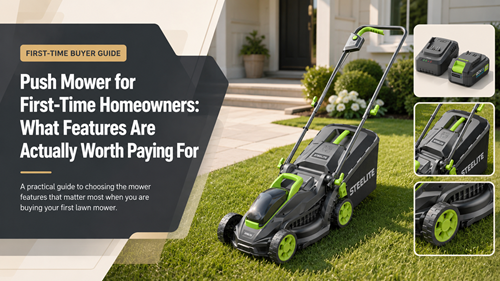
Push Mower For First-Time Homeowners is easiest to choose when the mower is matched to the property instead of being judged by power or deck size alone. A first mower purchase sets the pattern for years of lawn care. New owners often overpay for drive systems, cutting modes, or oversized decks before they know their yard’s slopes, obstacles, storage limits, and weekly growth pattern.
This guide is written for first-time homeowners purchasing their first lawn mower. A push mower for first-time homeowners should be simple enough that routine jobs—checking the blade, changing height, emptying the bag, charging batteries or adding fuel, and folding the handle—do not become reasons to delay mowing.
For a push mower for first-time homeowners, start by measuring and observing the yard before comparing models. Walk the property once before shopping. Estimate mowable area, identify slopes and gates, note the closest outlet or charging location, and measure storage. Those facts make feature comparisons much easier.
How To Choose A Push Mower For First-Time Homeowners
Buy for the lawn you actually have, not for the longest specification list. First-time homeowners usually benefit from reliable starting, simple height adjustment, manageable weight, easy blade and bag access, and a power system they are comfortable maintaining.
The right choice should make the normal weekly route easier, not merely win a specification comparison. Think about turning, transport, clipping handling, blade access, and the conditions that occur when the grass is growing fastest.
A useful buying test is to imagine the first ten minutes of mowing and the last ten minutes of cleanup. If the machine fits both parts of that routine, it is much more likely to remain a practical long-term purchase.
Features Worth Paying For On A First Mower
Beginner Lawn Mower Buying Tips
A beginner guide should start with yard size, slope, storage, and power preference. Those four facts eliminate more unsuitable mowers than comparing peak power numbers.
For a practical comparison, review beginner lawn mower buying tips and compare the dimensions or operating limits with your own yard.
Starter Mower For New House
A starter mower should have controls that are obvious without constant reference to the manual. Check how the bail, start button, drive control, and height levers feel.
When you narrow the shortlist, compare starter mower for new house against the route, grass condition, and storage limits you measured.
Essential Mower Features
Essential features include a safe blade-control system, practical height range, replacement-part availability, and a deck you can clean. Extra modes are useful only if you will use them.
A useful specification check is essential mower features while confirming that the exact model still matches the manufacturer instructions.
Easy Maintenance Mower
Low-maintenance does not mean maintenance-free. Cordless mowers remove oil and fuel work but still need blade care, battery storage, deck cleaning, and wheel inspection.
For this part of the decision, use easy maintenance mower as a reference point rather than assuming one feature guarantees overall performance.
Homeowner Mowing Equipment
Homeowner equipment should match the complete task, including trimming, edging, leaf handling, and storage. The mower is the core tool, not the only tool.
Before ordering, cross-check homeowner mowing equipment and focus on the specific characteristic discussed here, not the marketing headline alone.
First Lawn Care Tools
First lawn-care tools should be purchased around actual needs. A blade sharpener, extension cord, spare battery, trimmer, or cover can be more useful than an expensive feature bundle.
To connect the feature with a real mower or guide, review first lawn care tools before deciding whether that feature is worth paying for on your property.
Quick Comparison Table
Use this table to turn the topic into a shortlist. The “best” column is not a universal specification; it describes the direction that generally fits the condition in the first column.
| Situation | What to Prioritize | What to Watch |
|---|---|---|
| Small flat lawn | Simple push or cordless | Prioritize low weight |
| Larger lawn | More deck width or drive assist | Check runtime or fuel range |
| Slopes | Self-propelled may reduce effort | Confirm safe slope guidance |
| Storage | Folding handle helps | Measure before purchase |
| Maintenance | Easy blade and deck access | Verify local parts support |
A Practical Buying and Mowing Checklist
Use the checklist before purchase and again before the first mowing session. It keeps the decision grounded in yard measurements, safe operation, and maintenance rather than a single headline feature.
- Measure the lawn and storage space
- Choose a power type you can maintain
- Check gate width
- Compare mower weight
- Test height adjustment
- Review replacement blade cost
- Plan charging or fuel storage
- Read the safety manual before first use
A closely related planning step is covered in small-yard cutting-width comparison, which can help you compare another part of the same mowing workflow without repeating this article’s focus.
Mistakes That Cost Time or Cut Quality
- Buying the biggest mower for a small property
- Ignoring storage and battery or fuel safety
- Assuming cordless means zero maintenance
- Paying for features you cannot explain how you will use
Most of these mistakes come from optimizing one mower specification while ignoring the property. Measure first, use the manual’s operating limits, and make small adjustments after observing the first few mowing sessions.
Safety, Maintenance, and Ownership
Routine ownership still matters after the purchase. Keep the blade sharp, clean the deck with the power source disabled, inspect wheels and fasteners, and follow the manual for battery, cord, fuel, oil, and seasonal storage requirements.
Before every mow, inspect the area for stones, wire, toys, sticks, holes, people, and pets. Wear appropriate footwear and eye protection, keep guards in place, and never clear a chute or touch the blade area until the mower is fully disabled according to its manual.
For an authoritative safety or turf reference, review CPSC walk-behind mower safety information and apply it together with the instructions supplied for the exact mower model.
Final Buying Direction
A push mower for first-time homeowners should solve the property-specific problem described in this guide without creating new issues with access, cut quality, maintenance, or storage. The most useful specifications are the ones you can connect directly to a measurement or mowing condition in your own yard.
Shortlist two or three models, compare the complete mower footprint and approved operating features, verify blade and replacement-part support, and choose the machine that makes a safe repeatable weekly routine simplest.
Frequently Asked Questions
What mower type is easiest for a first-time homeowner?
For a small to medium flat yard, a simple push or cordless mower is often easy to learn. Larger or sloped lawns may justify self-propelled assistance.
How much should a new homeowner spend on a mower?
Set the budget after measuring the yard and identifying required features. Reliability, parts availability, and suitable capacity matter more than a fixed price target.
Do I need self-propelled drive?
Not for every lawn. It is most useful where the mower is heavy, the yard is larger, or slopes make steady pushing difficult.
Is a battery mower easier to own than gas?
Battery mowers avoid fuel and oil handling, but batteries need correct charging and storage and the mower still needs blade and deck maintenance.
What should I buy with my first mower?
At minimum, plan for eye and hearing protection as appropriate, blade maintenance, safe power or fuel handling, and any trimming tool your yard requires.