
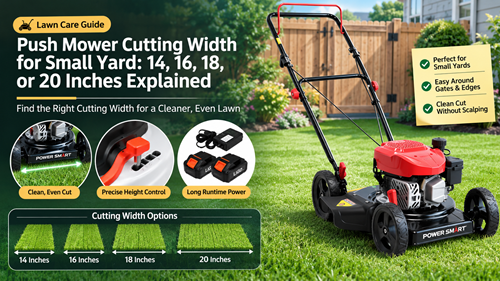
Push Mower Cutting Width For Small Yard is easiest to choose when the mower is matched to the property instead of being judged by power or deck size alone. Cutting width is one of the easiest mower specifications to compare and one of the easiest to overvalue. A few extra inches save distance on long straight runs, but they also increase the mower’s footprint and may add weight.
This guide is written for small-yard owners comparing mower deck widths before purchase. A push mower cutting width for small yard use should be chosen from the yard layout, not acreage alone. A 2,000-square-foot rectangle and a 2,000-square-foot lawn split by trees, beds, and narrow gates demand different machines.
For a push mower cutting width for small yard, start by measuring and observing the yard before comparing models. Measure the narrowest access point and estimate the longest open run. If most passes end after only a few seconds, maneuverability may save more time than a wider deck.
How To Choose A Push Mower Cutting Width For Small Yard
For a small yard, cutting width should be large enough to avoid unnecessary passes but small enough to move easily through gates, around beds, and into storage. A 14- or 16-inch deck favors maneuverability; 18- and 20-inch decks reduce pass count when the lawn has more open space.
The right choice should make the normal weekly route easier, not merely win a specification comparison. Think about turning, transport, clipping handling, blade access, and the conditions that occur when the grass is growing fastest.
A useful buying test is to imagine the first ten minutes of mowing and the last ten minutes of cleanup. If the machine fits both parts of that routine, it is much more likely to remain a practical long-term purchase.
What 14, 16, 18, And 20 Inches Change In Practice
14 Inch Mower Use Cases
A 14-inch deck is easy to place in narrow strips and around landscaping. The tradeoff is more passes and potentially a smaller bag or battery system.
For a practical comparison, review 14 inch mower use cases and compare the dimensions or operating limits with your own yard.
16 Inch Lawn Mower Benefits
A 16-inch mower remains compact but trims some of the pass-count penalty. It is a useful middle ground for townhome lawns and small fenced backyards.
When you narrow the shortlist, compare 16 inch lawn mower benefits against the route, grass condition, and storage limits you measured.
18 Inch Mower Coverage
An 18-inch deck starts to feel more efficient on open turf while staying manageable for many residential gates. Check total chassis width because it exceeds nominal cut width.
A useful specification check is 18 inch mower coverage while confirming that the exact model still matches the manufacturer instructions.
20 Inch Mower Suitability
A 20-inch mower can suit a small yard when access is generous and the lawn is mostly open. Weight and storage footprint become more important at this size.
For this part of the decision, use 20 inch mower suitability as a reference point rather than assuming one feature guarantees overall performance.
Compact Deck Width Guide
A deck-width guide should always include wheel stance, chute position, and bag depth. Nominal blade width does not equal the machine’s widest point.
Before ordering, cross-check compact deck width guide and focus on the specific characteristic discussed here, not the marketing headline alone.
Lawn Mower Deck Sizing
Deck sizing affects more than speed. Wider machines can bridge small dips differently and need more turning room, while narrow machines can follow contours more closely.
To connect the feature with a real mower or guide, review lawn mower deck sizing before deciding whether that feature is worth paying for on your property.
Quick Comparison Table
Use this table to turn the topic into a shortlist. The “best” column is not a universal specification; it describes the direction that generally fits the condition in the first column.
| Situation | What to Prioritize | What to Watch |
|---|---|---|
| 14 inch | Tight passages and very small lawns | Most passes |
| 16 inch | Compact all-around small-yard use | Moderate pass count |
| 18 inch | Small-to-medium open lawns | Needs more turning room |
| 20 inch | Open compact yards with wide access | Heavier and larger storage footprint |
| Any width | Must fit gate and storage route | Measure complete mower |
A Practical Buying and Mowing Checklist
Use the checklist before purchase and again before the first mowing session. It keeps the decision grounded in yard measurements, safe operation, and maintenance rather than a single headline feature.
- Measure gate width
- Estimate open-lawn run length
- Compare total mower width
- Check folded storage dimensions
- Consider mower weight
- Compare bag size
- Check battery runtime if cordless
- Choose width after mapping obstacles
A closely related planning step is covered in first-mower feature priorities, which can help you compare another part of the same mowing workflow without repeating this article’s focus.
Mistakes That Cost Time or Cut Quality
- Choosing width from lot size alone
- Assuming deck width equals overall width
- Ignoring extra turning room
- Buying a wide mower that cannot reach a side yard
Most of these mistakes come from optimizing one mower specification while ignoring the property. Measure first, use the manual’s operating limits, and make small adjustments after observing the first few mowing sessions.
Safety, Maintenance, and Ownership
Routine ownership still matters after the purchase. Keep the blade sharp, clean the deck with the power source disabled, inspect wheels and fasteners, and follow the manual for battery, cord, fuel, oil, and seasonal storage requirements.
Before every mow, inspect the area for stones, wire, toys, sticks, holes, people, and pets. Wear appropriate footwear and eye protection, keep guards in place, and never clear a chute or touch the blade area until the mower is fully disabled according to its manual.
For an authoritative safety or turf reference, review CPSC walk-behind mower requirements and apply it together with the instructions supplied for the exact mower model.
Final Buying Direction
A push mower cutting width for small yard should solve the property-specific problem described in this guide without creating new issues with access, cut quality, maintenance, or storage. The most useful specifications are the ones you can connect directly to a measurement or mowing condition in your own yard.
Shortlist two or three models, compare the complete mower footprint and approved operating features, verify blade and replacement-part support, and choose the machine that makes a safe repeatable weekly routine simplest.
Frequently Asked Questions
Is a 14-inch mower enough for a small yard?
Yes, especially for tight or highly landscaped lawns. It will simply require more passes than a wider deck.
Is 20 inches too wide for a small lawn?
Not if the gate, turning space, and storage are generous. On an open lawn it can reduce mowing time.
How much time does a wider deck save?
Savings depend on overlap, turns, obstacles, and walking speed. In irregular yards, extra width can be offset by slower maneuvering.
Should cutting width match gate width closely?
No. Leave practical clearance for the chassis, wheels, your hands, and steering corrections.
Does a wider deck use more battery?
It can require more power depending on blade load and design, but runtime depends on the entire mower system and grass conditions.
