
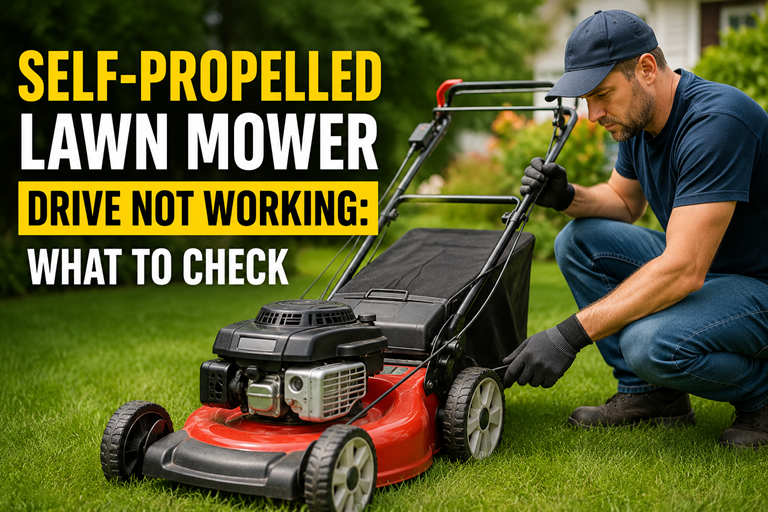
For owners whose self-propelled mower has lost drive, self-propelled lawn mower drive not working: what to check is most useful when it turns a broad topic into a few checks that can be measured, observed or confirmed.
The safest drive diagnosis starts outside the mechanism and moves inward only as far as the manufacturer authorizes an owner to go.
Confirm Drive Controls
Make sure the drive control is being engaged according to the mower instructions and that any speed control is not set unexpectedly.
A cutting blade that runs normally does not prove the drive control is engaged.
Wheels and Obstructions
With the mower safely off, inspect wheels and visible areas for wrapped grass, debris or physical blockage.
Do not reach into moving components or defeat safety controls to watch the drive operate.
Cable or Belt Symptoms
Some systems use mechanical cables or belts, while others use electrical drive components.
Visible looseness, damage or unusual noise can point toward service, but adjustment procedures are model-specific.
Battery or Engine Power
A cordless mower with a depleted battery or a gas mower that cannot maintain normal engine operation may also show weak or absent drive behavior.
Resolve the underlying power problem before assuming the transmission is at fault.
Service Boundary
Stop when diagnosis requires guard removal, transmission disassembly or adjustment not covered by the owner manual.
A self-propel system carries enough force that improvised repairs can create a control hazard.
A self-propelled mower can cut normally while the drive system fails, which helps separate blade power from wheel propulsion. Start with controls and visible wheel obstruction before assuming a transmission problem.
If the drive cable, belt or motor is hidden behind guards that the owner manual does not instruct you to remove, stop there. The drive mechanism can move with significant force and deserves model-specific service.
