
Lawn Mower Specifications Explained
Lawn Mower Specifications Explained takes a task-first approach for buyers who want to read mower listings accurately: define the lawn or equipment requirement, compare the relevant system, and verify the model-specific detail before acting.
Good specification reading is less about collecting numbers and more about refusing to turn missing information into invented certainty.
Cutting Specifications
Cutting width describes the swath, while cutting-height information describes the range or number of positions used to change grass height. A related practical check is covered in the brushless vs brushed mower guide.
Do not assume two mowers with the same width have the same physical size, height range or adjustment method. A related practical check is covered in the 2 in 1 vs 3 in 1 mower guide.
Power Specifications
Gas listings may show engine displacement, while electric models may show amperage, voltage, amp-hours or motor type. For a closely related detail, use the mower voltage amp hours guide.
These fields are not interchangeable performance scores; each describes a different part of the power system. For the next detailed comparison, see the lawn mower power sources.
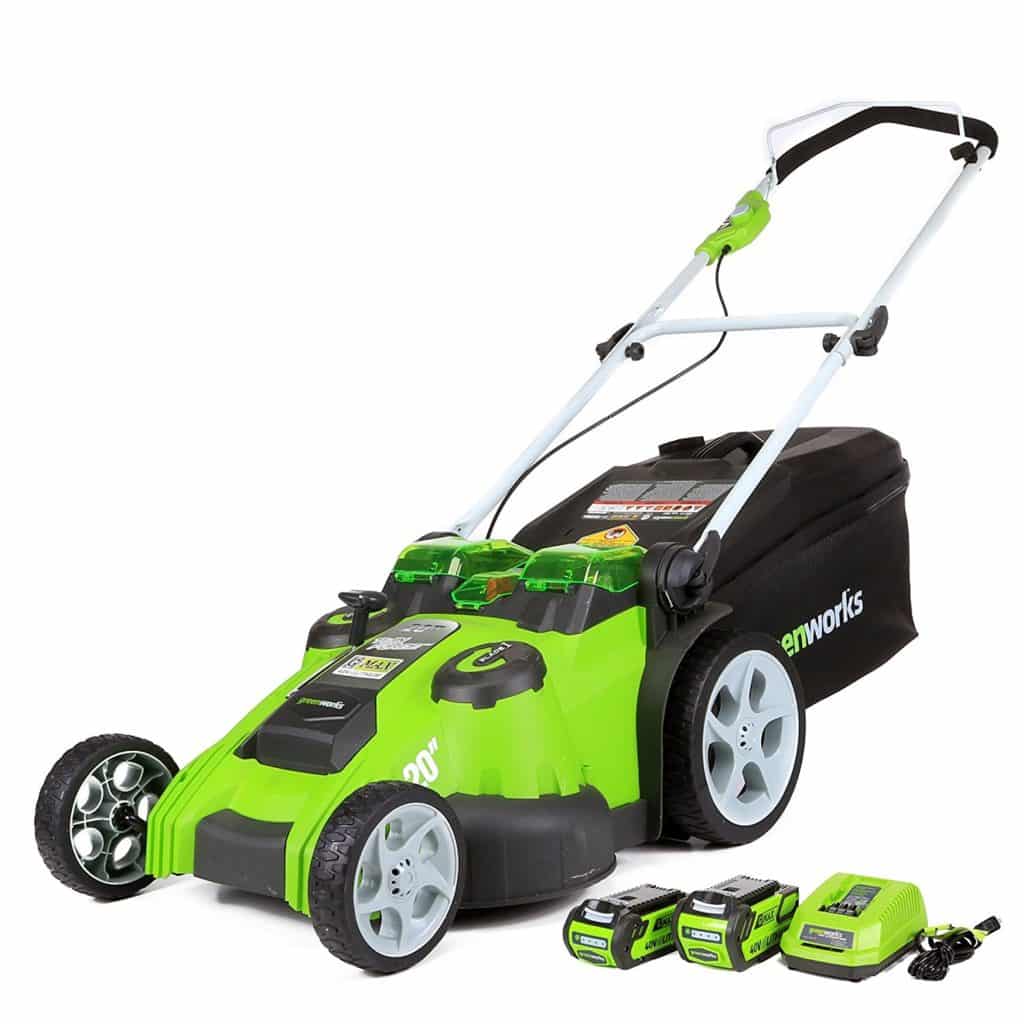
As a real-world lawn mower specifications reference, consider Greenworks 20-Inch 40V Twin Force Cordless Lawn Mower, 4.0 AH & 2.0 AH Batteries Included 25302. Keep the comparison evidence-based: stated details count, while unstated details remain unknown. Buy Now on Amazon.
Drive and Wheel Fields
Self-propelled listings may identify front-, rear- or all-wheel drive, and product titles sometimes state rear-wheel diameter or high-wheel construction.
Treat each confirmed field as a comparison point without filling in missing traction or speed details.
Clipping Modes
Mulching, bagging and discharge describe how clippings leave or remain under the deck.
A 2-in-1 or 3-in-1 label needs the actual supported modes to be clear; do not infer which three functions a manufacturer means when the listing does not say.
For a catalog-level lawn mower specifications example, look at EGO Power+ 20-Inch 56-Volt Lithium-ion Cordless Lawn Mower – Battery and Charger Not Included. Use only the specifications that the product record confirms, and leave any missing detail unassumed.
Weight and Package Contents
Weight affects handling, while package contents determine whether batteries, chargers, bags or other components are included. For the next detailed comparison, see the cordless mower runtime factors guide. Another useful cross-check is the lawn mower ownership costs.
The difference between “included” and “not included” can materially change the first-use cost of a cordless mower. For a closely related detail, use the cordless mower battery systems.
Unknown vs Confirmed Specs
An omitted specification is not a zero, a no, or permission to borrow a value from a similar model.
Mark it as unconfirmed and verify it on the manufacturer or current seller listing before a buying decision depends on it.
Specification fields should answer different questions. Cutting width describes pass size; voltage identifies an electrical system characteristic; amp-hours describe charge capacity; engine cc describes displacement; 3-in-1 describes a set of clipping functions only when those functions are named. Treating these fields as one performance scale creates bad comparisons. A related practical check is covered in the lawn mower sizing.
The safest interpretation of a missing field is “not confirmed.” A similar model from the same brand may have a steel deck, rear-wheel drive or an included charger, but that does not make the feature true for the product being viewed. A related practical check is covered in the lawn mower blades and decks guide.
For the lawn mower specifications decision, compare the criteria above with PowerSmart DB2194S 21" 3-in-1 161cc Gas Self Propelled Lawn Mower. Keep the comparison evidence-based: stated details count, while unstated details remain unknown.
For a catalog-level lawn mower specifications example, look at BLACK+DECKER CM2040 40V Lithium 3-in-1 Cordless Mower, 20". Use only the specifications that the product record confirms, and leave any missing detail unassumed.