
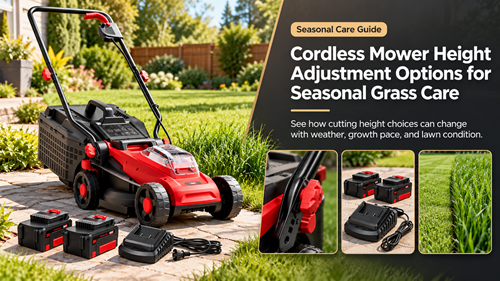
Cordless Mower Height Adjustment affects both cut quality and battery demand because the same lawn may need different settings through spring growth, summer heat, fall leaf season, or recovery after stress. A simple, repeatable adjustment system makes those changes easier.
Check the true minimum and maximum cutting heights, number of positions, whether one lever changes all wheels, how clearly settings are marked, and whether the deck stays level after adjustment. Match the available range to the grass species rather than chasing the lowest cut.
This guide focuses on height controls that make seasonal lawn care more consistent and easier to repeat.
How To Evaluate Cordless Mower Height Adjustment
Cordless Mower Height Adjustment should be evaluated around the work it must do every week, not around one headline number. Measure the lawn, identify narrow access points and obstacles, note the grass condition, and decide how clippings, charging or fuel, cleaning, and storage will be handled before comparing models.
For an example of the cordless mower height adjustment features, use the linked product page to compare the feature set with the requirements of your own yard rather than treating the listing as a universal recommendation.
A broader cordless mower height adjustment buying guide, can help separate category-level decisions from product-specific details, especially when several mower types could serve the same residential lawn.
Cordless Mower Height Adjustment Features That Matter In Real Use
Single-Lever Versus Multi-Lever Adjustment
A single lever is faster and helps keep all wheels aligned. Individual wheel levers can offer flexibility but require more attention to keep the deck level. This is worth checking on the exact model because a small design difference can change handling, cut consistency, or the amount of work required between mowing sessions.
Seasonal Height Changes
During heat or drought, many lawns benefit from retaining more leaf area. Rapid spring growth may require more frequent mowing rather than a dramatic height reduction. This is worth checking on the exact model because a small design difference can change handling, cut consistency, or the amount of work required between mowing sessions.
Battery Load And Cut Depth
Removing too much height in one pass increases blade load and can reduce runtime. A higher first pass followed by another cut later can be easier on the mower and turf. This is worth checking on the exact model because a small design difference can change handling, cut consistency, or the amount of work required between mowing sessions.
When the shortlist is down to a few models, review the exact cordless mower height adjustment specifications. Dimensions, capacity, adjustment ranges, included accessories, and power-system details should come from the current manufacturer or product record.
Specifications And Yard Fit
Level Deck Setup
After changing height, verify that all wheels are seated in matching positions and the mower sits level on flat ground. A tilted deck can create uneven stripes or scalping. Check how that feature interacts with the rest of the mower instead of assuming that a larger, faster, or heavier specification is automatically better.
Wheel And Lever Maintenance
Grass debris can collect around wheel brackets and height mechanisms. Clean them with the battery removed and follow the manual before lubricating any moving part. Check how that feature interacts with the rest of the mower instead of assuming that a larger, faster, or heavier specification is automatically better.
| Yard Situation | Priority | Why It Matters |
|---|---|---|
| Spring growth | Moderate height, mow often | Avoid removing too much at once |
| Summer heat | Often higher setting | Protect leaf area |
| Uneven lawn | Avoid lowest setting | Reduce scalping risk |
| Leaf cleanup | Choose height for airflow | Balance pickup and turf safety |
| Freshly sharpened blade | Recheck height | Cut quality can reveal deck tilt |
Setup, Maintenance, And Ownership
Build ownership cost into the decision by checking cordless mower height adjustment maintenance. Routine cleaning, blade or line care, battery or engine service, wheel inspection, and seasonal storage all affect how reliably the equipment performs after the first month.
Before the first mowing session, follow a safe cordless mower height adjustment setup. Read the owner’s manual, inspect the work area, set the machine on stable ground, and keep hands and feet away from the cutting system whenever power could be available.
Pre-Mowing Ownership Checklist
- Identify the grass type
- Measure current mowing height
- Remove the battery before adjustment
- Set all wheels evenly
- Test on a flat section
- Inspect cut quality after the first strip
- Record the successful seasonal setting
Keep the owner’s manual, model number, battery or engine details, and replacement-part information together. That small record makes future maintenance and parts ordering much easier and reduces the risk of using an incompatible blade, battery, line, oil, or accessory.
A Practical Comparison Checklist
For homeowners deciding whether this format genuinely fits the property, use cordless mower height adjustment for home lawns. Compare the recommendation with lawn area, access, slopes, obstacles, grass type, and the time available for each mowing session.
A useful final cross-check is a cordless mower height adjustment comparison. Compare only the specifications that affect your own yard, then eliminate models that miss a non-negotiable requirement such as access width, cutting height, runtime, storage, or safe operating range.
After narrowing the list, compare total ownership rather than purchase price alone. Replacement blades or line, batteries, chargers, fuel, oil, filters, collection bags, extension cords, and storage accessories can change long-term cost and convenience.
Common Buying Mistakes
- Using the lowest setting because it looks tidy immediately
- Changing only one wheel on a multi-lever deck
- Lowering several positions at once on overgrown grass
- Adjusting height with the battery installed
- Ignoring grass-species height recommendations
Avoid solving these problems by forcing the mower to work outside its intended conditions. A safer buying decision starts with the property and mowing routine, then chooses equipment whose published limits comfortably cover that work.
Choose Height Adjustment Around Seasonal Grass Needs
Cordless Mower Height Adjustment should make seasonal changes repeatable without turning every mowing session into a setup task. The useful range depends on grass type, weather, shade, growth rate, and how easily the mower can move between positions while staying level.
Compare the number of positions, actual minimum and maximum cutting heights, adjustment mechanism, wheel relationship, and deck clearance. Choose a mower whose range covers the lawn throughout the growing season rather than paying for positions that do not match the grass you maintain.
Frequently Asked Questions
What cutting height should I use on a cordless mower?
The correct height depends on the grass species, season, and lawn condition. Use local turf guidance rather than one universal setting.
Does cutting lower reduce battery runtime?
It can when the blade must remove more material or work through dense grass. Cutting load is a major factor in cordless runtime.
Is single-lever height adjustment better?
It is convenient and helps keep the deck level, but durability and range still matter. A well-designed multi-lever system can also work well.
Can I change cutting height with the battery installed?
Follow the owner’s manual. As a safety practice, remove or disable the power source before working around adjustment mechanisms or the blade area.
Why is the mower cutting unevenly after adjustment?
Check that all wheels are fully seated at the same position, tire or wheel condition is normal, and the deck or blade is not damaged.