
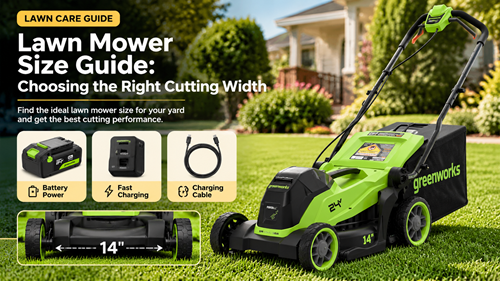
A lawn mower size guide should match cutting width to the shape of the property, not just its square footage. Wider decks reduce the number of passes on open lawns, while narrower decks fit gates, turn around landscaping more easily, and often weigh less.
Deck width also affects storage, blade length, power demand, bagging airflow, and how close the mower can work around obstacles. A wide mower that saves five straight passes may lose that advantage if it cannot enter a side yard.
This guide shows how to measure the property and choose a cutting width that balances coverage with maneuverability.
How A Lawn Mower Size Guide Uses Real Yard Measurements
Cutting width is usually the width of the blade path, not the mower’s total outside width. Wheels, deck guards, discharge chutes, and handles can make the actual machine wider, so verify full dimensions before relying on a gate measurement.
A wider deck means fewer passes, but each turn may require more room. Properties with many trees, beds, or narrow strips can favor a smaller mower even when total acreage suggests a larger one.
Power source interacts with size. A wider battery deck may need more stored energy under heavy load, while a larger gas mower may add weight that affects pushing and storage.
Lawn Mower Size Guide Measurements That Matter
Cutting Width
Cutting width controls how much grass is covered per pass and how easily the mower fits narrow zones.
Compare mower cutting width only after measuring the narrowest route the mower must travel.
Overall Deck Dimensions
Deck guards, wheels, and discharge components can extend beyond the blade path.
The advertised deck size should be checked against assembled outside dimensions before purchase.
Property Shape
Long open rectangles reward width more than small gardens filled with obstacles.
Map yard dimensions by sections so the mower is sized for the route rather than the property record.
Pass Count And Turns
Wider decks reduce straight passes but can make every turn slower or more awkward.
Real mowing efficiency depends on turns, bag emptying, obstacles, and walking pace as well as deck width.
Homeowner-Friendly Scale
A residential mower should fit storage and operator strength as well as lawn area.
A sensible residential lawn mower size balances coverage with weight and storage rather than chasing commercial dimensions.
Complete Equipment Selection
Cutting width influences blade replacement, bag size, transport, and storage accessories.
Use garden equipment selection to compare mower formats and accessory availability at the same time.
Cutting Width By Yard Pattern
These ranges are decision examples, not universal acreage rules.
| Yard Pattern | Likely Priority | Width Strategy |
|---|---|---|
| Tiny garden with gates | Access and turning | Choose compact |
| Small open rectangle | Pass reduction | Moderate width |
| Small yard with many trees | Maneuverability | Narrow to moderate |
| Medium open lawn | Coverage | Moderate to wider |
| Sloped lawn | Control and weight | Avoid excess size if hard to handle |
The mower must also fit through storage doors and into the vehicle if it will be transported for service.
Measure Before Comparing Models
A tape measure and a simple sketch can prevent the most common size mismatch.
- Measure narrowest gate
- Measure storage door
- Measure side-yard width
- Sketch trees and beds
- Estimate open straight-run length
- Check mower outside width
- Compare assembled handle length
- Confirm transport needs
Leave practical clearance around gates and walls. A mower that technically fits with millimeters to spare can still be frustrating to use every week.
Cutting Width Mistakes
- Choosing by acreage alone
- Confusing blade width with total mower width
- Ignoring storage-door clearance
- Buying a wide deck for an obstacle-heavy yard
- Ignoring extra battery load on a wider deck
- Forgetting bag and discharge-chute dimensions
Cutting width should reduce total work. If a larger mower creates routing or storage problems, the extra blade width is not an efficiency gain.
Size, Control, And Safety
Make turns at a controlled pace and keep the mower stable on slopes. A larger deck has more rotating blade length and may require more room around obstacles and bystanders.
Use only blades and replacement parts made for the exact deck. Do not modify guards or discharge components to make a mower fit a narrow route.
Federal walk-behind mower safety requirements and operating guidance are summarized by the U.S. Consumer Product Safety Commission.
Choose The Widest Mower That Still Fits Comfortably
A lawn mower size guide should help you balance pass count, turning room, storage, weight, and access. Wider is faster only when the property lets the mower use that width efficiently.
Measure gates and storage first, then choose a deck that handles the open lawn without becoming awkward around landscaping. That is the size that will save time in real use.
Frequently Asked Questions
What lawn mower width is best for a small yard?
Choose a deck that clears gates and turns comfortably around obstacles. Open small lawns can use more width than cramped garden layouts.
Is cutting width the same as mower width?
No. Wheels, guards, and discharge components can make the mower wider than its cutting path.
Does a wider mower use more battery?
It can under similar conditions because a larger blade system may require more power, but motor efficiency and deck design also matter.
Can a mower be too small?
Yes. A very narrow deck can create many extra passes on an open lawn and increase total mowing time.
Should storage space affect mower size?
Yes. Measure doors, shelves, handle-folding space, and approved storage position before buying.