
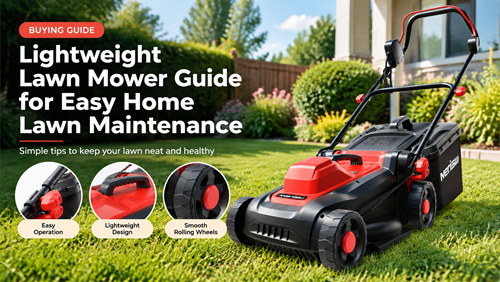
A lightweight lawn mower can make turns, transport, storage, and everyday pushing easier, especially on compact properties. Low weight can also reduce traction, deck rigidity, bag stability, and momentum through thick grass, so the lightest machine is not automatically the easiest mower to use.
The useful comparison is total operating effort. A slightly heavier self-propelled mower may demand less pushing on a slope, while a very light manual push mower may be ideal on a flat garden with many tight turns.
This guide helps homeowners compare weight together with deck size, handle ergonomics, wheel design, power source, and storage.
When A Lightweight Lawn Mower Makes Sense
Weight matters most when the mower must be carried over steps, lifted into storage, turned repeatedly around landscaping, or pushed by someone who tires easily.
Published mower weight may exclude batteries, fuel, or a full grass bag. Compare operating weight, not just the bare-tool number.
A narrow lightweight deck can feel agile, but too little mass over the wheels can reduce traction on rough ground. The goal is controlled movement, not simply the lowest number on a specification sheet.
Lightweight Lawn Mower Features To Compare
Carry And Lift Weight
Consider where the mower must be moved when it is not cutting, including steps, sheds, vehicle transport, or wall storage.
A portable mower should have secure lifting points and a weight you can handle without awkward posture.
Rolling Resistance
Wheel bearings, tire diameter, deck balance, and grass conditions can matter as much as total mass.
An easy push mower should roll smoothly and track straight without requiring constant correction.
Beginner-Friendly Controls
Simple starting, clear height adjustment, and intuitive safety controls make learning easier.
Good beginner lawn equipment reduces setup confusion without removing essential safety features.
Compact Storage
Folding handles and a short deck can save floor space, while battery removal may simplify shelf storage.
Choose compact yard tools with storage positions approved by their manufacturers.
Ergonomic Mowing Pace
Handle height, grip shape, vibration, wheel drag, and bag weight all influence fatigue.
Real comfortable mowing comes from total ergonomics rather than mower weight alone.
Residential Fit
Lightweight mowers are strongest when grass is maintained regularly and the yard does not demand heavy commercial construction.
A residential mower should match weekly grass load, clipping method, and expected ownership years.
Weight Versus Feature Tradeoffs
Added features often add mass, so decide which ones solve a real problem.
| Feature | Possible Benefit | Weight / Complexity Cost |
|---|---|---|
| Larger steel deck | Durability and coverage | More mass |
| Self-propel drive | Less pushing effort | Heavier drive system |
| Large battery | Longer runtime | More carry weight |
| Large grass bag | Fewer emptying stops | Heavier when full |
| Folding handle | Smaller storage footprint | Hinges and locks to maintain |
Operating effort is the target. A feature can add weight while still making the mower easier to use overall.
Test A Lightweight Mower Before Buying
If possible, simulate the movements your yard requires rather than only lifting the mower once.
- Check published bare weight
- Add battery or fuel weight
- Estimate full bag weight
- Push on grass if possible
- Make several tight turns
- Adjust handle height
- Fold the handle
- Measure storage clearance
A mower that feels easy empty may feel different with a full bag or large battery installed, so compare the complete operating configuration.
Lightweight Mower Buying Mistakes
- Choosing the lowest weight without checking cut capacity
- Ignoring bag and battery weight
- Using small wheels on rough terrain without testing
- Assuming plastic deck always means weak or steel always means better
- Buying self-propel solely because the mower is heavier
- Overloading a light mower with tall wet grass
Low weight is an advantage only when the mower remains stable, durable, and capable of handling normal grass conditions.
Transport, Storage, And Safe Handling
Lift only from approved points and use two people when the mower is heavier than you can control safely. Remove batteries or fuel components only when the manual instructs you to do so.
Secure folding handles before mowing and confirm all latches are locked. Do not use a storage position that could leak fuel or damage the battery system.
For general walk-behind mower operating precautions, review the CPSC power mower safety guidance before deciding how to lift, service, or transport a mower.
Choose Low Effort, Not Just Low Weight
A lightweight lawn mower is valuable when it reduces turning, carrying, and storage effort without sacrificing the cutting capacity the yard needs. Deck width, wheel control, handle ergonomics, power source, and bag weight all belong in the decision.
Test the complete operating configuration and choose the mower that stays easy to control from the first pass to the last.
Frequently Asked Questions
How light is a lightweight lawn mower?
There is no universal cutoff. Compare models in the same category and include batteries, fuel, and a full bag when estimating operating weight.
Are lightweight mowers good for seniors?
They can reduce pushing and lifting effort, but handle ergonomics, safety controls, wheel drag, and terrain also matter.
Is a plastic deck bad?
Not automatically. Composite decks can reduce weight and resist corrosion, while design quality and impact resistance vary by model.
Can a lightweight mower handle thick grass?
Some can, but power, deck airflow, blade condition, cutting height, and pace matter. Avoid forcing a light mower through extreme overgrowth.
Is self-propelled better than lightweight push?
It depends on the yard. Self-propel can reduce pushing effort on slopes, while a light push mower can be simpler on flat compact lawns.