
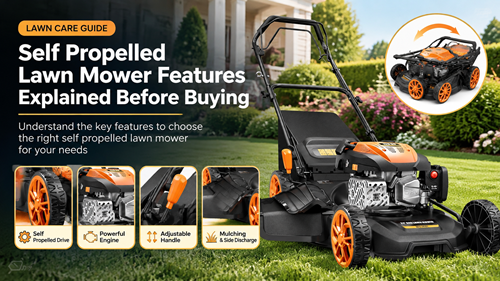
Self propelled lawn mower features matter because the drive system changes how the mower feels before it changes how the grass looks. The blade still creates the cut, but wheel drive can reduce pushing effort on slopes, long routes, and heavier machines.
Drive type, speed control, wheel size, traction, handle controls, mower weight, and turning behavior determine whether self-propel feels natural or fights the operator. A feature that looks helpful in a specification table can become annoying if the drive engages abruptly or moves faster than a comfortable walking pace.
This guide explains which drive features are worth testing before paying extra for propulsion.
How Self Propelled Lawn Mower Features Change The Experience
Front-wheel drive can be easy to maneuver because lifting the front wheels reduces traction and helps pivot, while rear-wheel drive can feel more planted on slopes. All-wheel-drive systems add traction but also cost, weight, and mechanical complexity.
Speed control matters as much as drive location. A mower that cannot move slowly enough through thick grass or tight areas may be harder to control than a manual push machine.
Remember that drive assistance does not increase blade cutting quality by itself. The deck, blade, engine or motor, mowing height, and walking pace still determine the grass finish.
Self Propelled Lawn Mower Features To Test
Drive Engagement
The control should engage predictably without forcing the operator to grip awkwardly for an entire mowing session.
A self drive mower should feel easy to disengage when turning, backing away from obstacles, or crossing non-grass surfaces.
Variable Speed
A useful range lets the mower slow down for thick growth and speed up on open easy sections.
A variable speed mower is most valuable when the control has a comfortable low setting, not merely a high top speed.
Yard Size And Distance
Drive assistance becomes more valuable as the route gets longer, the machine gets heavier, or slopes increase.
A large yard mower still needs enough fuel or battery reserve to complete the longer route.
Handle Ergonomics
Speed levers, paddles, and bars should match hand position without constant strain.
Real mowing comfort depends on handle height, vibration, mower weight, and how much force the controls require.
Useful Automation
Some models add load sensing, selectable drive modes, or electronic controls. These can help only when they simplify operation.
Compare advanced lawn mower functions against the basic need for predictable cutting and control.
Routine Ownership
Drive belts, cables, gears, wheels, or electronic drive components add service points beyond a basic push mower.
Plan for easy lawn maintenance by checking parts availability and service access before buying.
Drive Type Comparison
Drive layout influences traction and turning feel, but exact model behavior varies.
| Drive Type | Typical Strength | Typical Tradeoff |
|---|---|---|
| Front-wheel drive | Easy pivoting on flat lawns | Can lose traction when front is lifted |
| Rear-wheel drive | Good traction on slopes | Can feel heavier in tight turns |
| All-wheel drive | Maximum traction in varied terrain | More complexity and weight |
| Adaptive/personal pace | Speed follows operator input | Control feel varies by design |
Whenever possible, push and turn the mower before buying. Control feel is difficult to judge from a feature list.
Test Drive Assistance Before Committing
If a dealer or demonstration is available, reproduce the motions that happen most often on your lawn rather than only walking straight across flat pavement.
- Start at the lowest drive speed
- Engage and release several times
- Make a tight turn
- Walk across a mild slope
- Push with drive disengaged
- Check reverse handling
- Adjust handle height
- Test bag weight if possible
A mower should remain controllable when the drive is off. That matters around gates, landscaping, and storage areas where powered movement may be inappropriate.
Self-Propelled Buying Mistakes
- Choosing top speed instead of comfortable low speed
- Assuming drive type guarantees traction
- Ignoring mower weight when drive is off
- Buying more traction than a flat yard needs
- Forgetting drive maintenance and parts
- Using maximum speed through thick grass
Drive assistance should reduce effort without taking control away from the operator. If it adds tension or awkwardness, the feature is not doing its job.
Drive System Care And Safe Use
Keep wheels, drive components, and the underside of the mower clean according to the manual. Inspect cables or controls for changes in engagement and address slipping or surging before it becomes a safety problem.
Do not use self-propel to pull the mower toward your feet, and disengage the drive before crossing gravel, pavement, or other surfaces when the manual directs.
Walk-behind mower designs are subject to federal safety requirements; the CPSC summarizes them in its walk-behind power mower guidance along with general operating precautions.
Pay For Drive Assistance When It Solves A Real Effort Problem
Self propelled lawn mower features are worth the premium when they improve control and reduce fatigue on a specific property. Drive location, speed range, traction, handle feel, and serviceability matter more than simply seeing “self-propelled” on the box.
Test the mower at low speed and through turns, then make sure the cutting system and power source still fit the grass and mowing time.
Frequently Asked Questions
Is rear-wheel drive better than front-wheel drive?
Rear-wheel drive often provides strong traction on slopes, while front-wheel drive can be easier to pivot on flatter lawns. Exact mower design matters.
Does self-propel use more battery?
Yes, on battery mowers the drive system consumes energy, so runtime can decrease depending on speed, slope, and load.
Can a self-propelled mower be pushed manually?
Most can be moved with the drive disengaged, but resistance varies by model. Test this if storage or tight turns require manual movement.
What is a good self-propel speed range?
The lowest comfortable speed matters most for thick grass and tight areas. The best range matches your walking pace.
Do self-propelled mowers need more maintenance?
They add drive components that may need inspection, adjustment, or replacement beyond normal blade and deck care.