
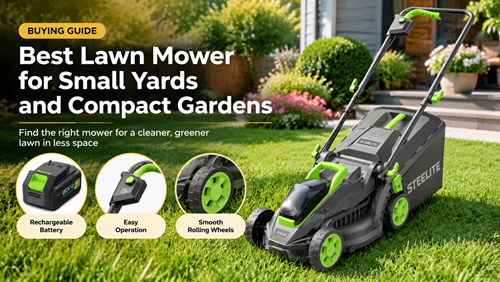
A lawn mower for small yard use should reduce effort in tight spaces rather than simply copy the specifications of a larger suburban machine. Compact gardens often include gates, raised beds, trees, paths, patio edges, and short turning zones where width, weight, and handle geometry matter more than maximum power.
A smaller mower can also simplify storage and reduce the time spent trimming around obstacles, but going too narrow adds unnecessary passes on an open lawn. The best size balances access with coverage.
This guide helps homeowners measure the route, choose an appropriate power system, and identify storage and clipping features that make compact mowing easier.
How To Match A Lawn Mower For Small Yard Use
Start with access. A mower that cannot pass through a side gate or turn between beds creates more work no matter how quickly it cuts in a straight line. Leave clearance for hands and wheel movement rather than matching the mower width exactly to the opening.
Next consider total route length. A very small deck is agile but increases passes. On a rectangular lawn with few obstacles, a slightly wider deck may actually be easier despite its larger footprint.
Finally, plan where the mower will live. Folding handles, vertical storage approval, battery removal, cord storage, and fuel restrictions can be more important in a small home than one additional cutting-height setting.
Lawn Mower For Small Yard Features Worth Prioritizing
Compact Deck Width
A compact deck improves access around beds and narrow paths but should still cover the main lawn efficiently.
A compact lawn mower is most useful when its width solves a measured access problem.
Simple Garden Maneuvering
Low weight and short front-to-back length reduce the effort required to pivot around trees and garden borders.
Match small garden equipment to the actual obstacles rather than total lot size.
Low Carry And Push Weight
Stairs, sheds, and tight turns make weight more noticeable than they are on an open flat lawn.
A lightweight mower may reduce fatigue for compact properties with frequent direction changes.
Storage Footprint
Folding handles can shrink the footprint, while some electric mowers are approved for vertical storage.
An easy storage mower should still be stored exactly as the manufacturer allows, especially when batteries or fuel are involved.
Urban Noise And Schedule
Smaller properties place the mower closer to neighbors, walls, and windows, making noise and mowing time more noticeable.
Thoughtful urban lawn care may favor quieter electric or manual options where the lawn size allows them.
Backyard-Specific Clipping
A small bag can fill quickly in spring growth, while mulching can reduce disposal when conditions are suitable.
Choose a backyard mower with a clipping method that matches how you actually maintain the property.
Small-Yard Mower Formats
Use the table to identify which compromises fit a compact property.
| Format | Strength In Small Yards | Watch For |
|---|---|---|
| Reel mower | Very light, quiet, simple storage | Needs frequent mowing and suitable grass |
| Corded electric | Light and no battery replacement | Cord route and outlet access |
| Battery push | Flexible routing and easy start | Runtime and battery cost |
| Small gas push | Fast refueling and familiar power | Weight, noise, fuel care |
| Self-propelled compact mower | Less pushing effort | Added weight and complexity |
The smallest machine is not automatically the best. Choose the smallest deck that still covers the open lawn at a comfortable pace.
Measure A Compact Yard Before Shopping
A ten-minute measurement session can eliminate many poor choices before you compare models.
- Measure the narrowest gate
- Measure the tightest turn
- Estimate open lawn width
- Count steps or stairs to storage
- Measure storage footprint
- Check outlet locations
- Decide clipping disposal method
- Set a maximum mower weight
Write the measurements down and compare them with the assembled mower dimensions, not only the advertised deck width.
Small-Yard Buying Mistakes
- Buying a large deck because it is faster on paper
- Ignoring handle swing around beds
- Choosing self-propelled drive for a tiny flat lawn without testing weight
- Forgetting where the cord or battery charger will live
- Choosing a tiny grass bag for fast spring growth
- Storing a gas mower in an unsuitable enclosed space
Compact yards reward simple equipment. Every feature should solve a real access, cutting, or storage problem.
Safe Mowing Around Tight Obstacles
Walk the yard before mowing and remove toys, stones, branches, wire, and other debris. Keep feet away from the deck when turning near borders, and do not pull a running mower toward yourself unless the manual specifically describes a safe maneuver.
Trim around fixed obstacles separately when the mower cannot approach safely. Trying to force a wide deck against walls, roots, or edging can damage the blade or the landscape.
For walk-behind mower operating precautions, review the CPSC power lawn mower safety guide and the manual for your exact machine.
Use Compact Size To Reduce Work, Not Cutting Quality
A lawn mower for small yard use should fit gates, turns, storage, and the person pushing it. Compact dimensions are valuable only when the mower still has enough cutting width and power for the lawn’s normal growth.
Measure first, choose the simplest suitable power system, and keep the blade sharp. That combination usually saves more time than buying an oversized mower for a small garden.
Frequently Asked Questions
What deck width is best for a small yard?
It depends on gate width, obstacles, and open lawn area. Choose a deck that clears tight access while avoiding excessive passes.
Is a reel mower good for a small lawn?
It can be excellent on level lawns that are cut frequently and kept within the reel mower’s grass-height range.
Do small yards need self-propelled mowers?
Often they do not, especially when flat. Slopes, physical effort, and mower weight are better reasons to add drive assistance.
Is battery or corded electric better for a compact yard?
Battery offers route freedom, while corded models avoid battery aging. Outlet locations and mowing pattern determine which is more convenient.
How should I store a mower in a small shed?
Use only storage positions approved by the manufacturer, keep the area dry, and follow battery or fuel storage requirements.