
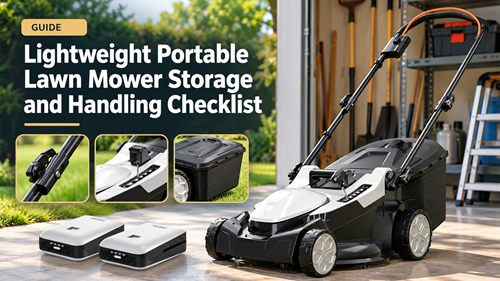
A Lightweight Portable Lawn Mower can simplify small-lawn care when equipment must pass through gates, move over steps, or fit into crowded storage. Portability should be judged with the battery, bag, and accessories installed, not from tool-only weight alone.
Compare operating weight, balanced lifting points, folded dimensions, handle locks, deck material, wheel size, power-source storage, and whether vertical storage is explicitly allowed. A slightly heavier mower with better balance can be easier to handle than a lighter awkward design.
This guide keeps storage, lifting, transport, and everyday handling at the center of the buying decision.
How To Evaluate Lightweight Portable Lawn Mower
Lightweight Portable Lawn Mower should be evaluated around the work it must do every week, not around one headline number. Measure the lawn, identify narrow access points and obstacles, note the grass condition, and decide how clippings, charging or fuel, cleaning, and storage will be handled before comparing models.
For an example of the lightweight portable lawn mower features, use the linked product page to compare the feature set with the requirements of your own yard rather than treating the listing as a universal recommendation.
A broader lightweight portable lawn mower buying guide, can help separate category-level decisions from product-specific details, especially when several mower types could serve the same residential lawn.
Lightweight Portable Lawn Mower Features That Matter In Real Use
Operating Weight
Battery packs, grass bags, and attachments can add meaningful weight. Compare ready-to-mow weight whenever the manufacturer publishes it. This is worth checking on the exact model because a small design difference can change handling, cut consistency, or the amount of work required between mowing sessions.
Handle Fold And Locks
A folding handle should lock securely during mowing and collapse without pinching cables or controls. Measure the folded footprint rather than trusting the word compact. This is worth checking on the exact model because a small design difference can change handling, cut consistency, or the amount of work required between mowing sessions.
Lifting And Carrying
Look for a stable central handle or clearly described lifting points. Never lift by control cables, battery covers, or plastic panels not designed as handles. This is worth checking on the exact model because a small design difference can change handling, cut consistency, or the amount of work required between mowing sessions.
When the shortlist is down to a few models, review the exact lightweight portable lawn mower specifications. Dimensions, capacity, adjustment ranges, included accessories, and power-system details should come from the current manufacturer or product record.
Specifications And Yard Fit
Storage Orientation
Some electric mowers support vertical storage, while gas machines often have strict orientation rules because of fuel and oil. Follow the exact manual to prevent leaks or damage. Check how that feature interacts with the rest of the mower instead of assuming that a larger, faster, or heavier specification is automatically better.
Deck And Wheel Durability
Light construction improves handling but should still feel rigid around wheel mounts and deck edges. Inspect replaceable wear items and parts availability. Check how that feature interacts with the rest of the mower instead of assuming that a larger, faster, or heavier specification is automatically better.
| Yard Situation | Priority | Why It Matters |
|---|---|---|
| Apartment-style garage | Folded footprint | Save floor space |
| Steps to lawn | Operating weight | Reduce carrying strain |
| Narrow gate | Overall width | Avoid scraping or lifting |
| Battery mower | Pack removal | Lower carry weight if allowed |
| Frequent transport | Secure handle locks | Prevent movement in vehicle |
Setup, Maintenance, And Ownership
Build ownership cost into the decision by checking lightweight portable lawn mower maintenance. Routine cleaning, blade or line care, battery or engine service, wheel inspection, and seasonal storage all affect how reliably the equipment performs after the first month.
Before the first mowing session, follow a safe lightweight portable lawn mower setup. Read the owner’s manual, inspect the work area, set the machine on stable ground, and keep hands and feet away from the cutting system whenever power could be available.
Pre-Mowing Ownership Checklist
- Measure storage height and depth
- Confirm operating weight
- Locate approved lifting points
- Test handle-fold controls
- Check gate and stair clearance
- Read transport and vertical-storage instructions
- Remove debris before indoor storage
Keep the owner’s manual, model number, battery or engine details, and replacement-part information together. That small record makes future maintenance and parts ordering much easier and reduces the risk of using an incompatible blade, battery, line, oil, or accessory.
A Practical Comparison Checklist
For homeowners deciding whether this format genuinely fits the property, use lightweight portable lawn mower for home lawns. Compare the recommendation with lawn area, access, slopes, obstacles, grass type, and the time available for each mowing session.
A useful final cross-check is a lightweight portable lawn mower comparison. Compare only the specifications that affect your own yard, then eliminate models that miss a non-negotiable requirement such as access width, cutting height, runtime, storage, or safe operating range.
After narrowing the list, compare total ownership rather than purchase price alone. Replacement blades or line, batteries, chargers, fuel, oil, filters, collection bags, extension cords, and storage accessories can change long-term cost and convenience.
Common Buying Mistakes
- Comparing bare-tool weight with fully equipped mowers
- Assuming every mower can be stored vertically
- Lifting by cables or folding handles not rated as carry points
- Ignoring battery removal before transport when the manual requires it
- Choosing the lightest mower without considering deck rigidity
Avoid solving these problems by forcing the mower to work outside its intended conditions. A safer buying decision starts with the property and mowing routine, then chooses equipment whose published limits comfortably cover that work.
Choose A Lightweight Mower That Is Easy To Store And Handle
A Lightweight Portable Lawn Mower is a strong fit when lifting, tight storage, narrow paths, or frequent repositioning matter more than maximum deck size. Low weight helps only when the mower still has enough stability, cutting range, power capacity, and wheel control for the lawn.
Check the actual dry weight, folded dimensions, carrying points, battery or cord storage, handle locks, and replacement-part availability. The best compact setup should be easy to move before and after mowing without sacrificing the basic cutting performance the property needs.
Frequently Asked Questions
What counts as a lightweight lawn mower?
There is no universal cutoff. Compare ready-to-mow weight, balance, and how far the mower must be carried in your own routine.
Can a lightweight mower be stored vertically?
Only if the manufacturer explicitly permits that orientation. Gas and electric designs can have very different storage rules.
Does a plastic deck make a mower less durable?
Not automatically. Polymer decks can resist corrosion, but durability depends on design, material quality, wheel mounts, and intended use.
Should I remove the battery before carrying a cordless mower?
Follow the manual. Removing the battery can reduce weight and prevent accidental starting when the manufacturer instructs it.
Is a lighter mower better on slopes?
Weight is only one factor. Traction, wheel design, slope limits, and operator stability are more important for safe slope use.