
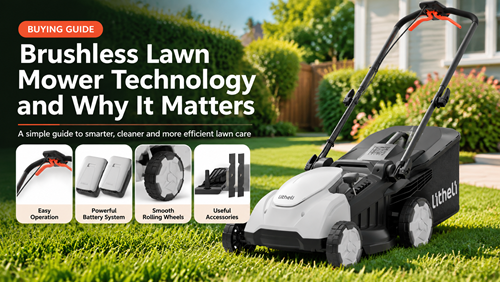
A brushless lawn mower uses an electronically controlled motor without the carbon brushes found in traditional brushed DC motors. Removing that wear component can improve efficiency, reduce maintenance inside the motor, and allow more precise electronic control of speed and torque.
Brushless does not guarantee that the complete mower is efficient, durable, or powerful. Battery quality, controller design, cooling, blade, deck airflow, bearings, wiring, and software all influence real performance.
This guide explains what brushless technology can improve and which mower-level features still need to be evaluated separately.
How A Brushless Lawn Mower Motor Works
A brushed motor mechanically switches current through brushes and a commutator. A brushless motor uses electronic switching to energize motor windings, which removes brush friction and wear.
Electronic control can adjust motor output as load changes. Some mowers increase blade speed in thick grass and reduce it in light grass to save energy, though the exact strategy varies by manufacturer.
Because brushless motors depend on electronics, the controller and thermal design become important service and durability considerations. A robust motor paired with weak electronics does not create a robust mower.
Brushless Lawn Mower Benefits To Evaluate
Reduced Brush Wear
Without carbon brushes, one routine wear item is eliminated from the motor.
A brushless motor mower can still have bearings, controllers, switches, and drive parts that require long-term reliability.
Energy Efficiency
Lower electrical and friction losses can help more battery energy reach the blade.
An efficient lawn mower also depends on blade sharpness, deck airflow, grass load, and self-propel use.
Battery Use Under Load
Electronic control can vary power demand as cutting conditions change.
Real battery performance should be judged in thick grass and on the full mowing route, not from motor type alone.
Electronic Motor Control
Controllers can manage startup, current, speed, and thermal protection.
Modern motor technology is useful when the control system is well matched to the battery and deck.
Durability Of The Whole Machine
The motor may have fewer wear parts, but deck construction, wheels, controls, wiring, and battery seals still matter.
A durable mower design should be evaluated component by component rather than by the brushless label alone.
Platform Value
Brushless mowers are common in battery ecosystems that also power trimmers, blowers, and other yard tools.
Compare modern gardening equipment across the full battery platform so the mower purchase supports future tools.
Brushless Versus Brushed Motor Basics
This table compares motor architecture, not complete mower quality.
| Factor | Brushless Motor | Brushed Motor |
|---|---|---|
| Commutation | Electronic | Mechanical brushes/commutator |
| Brush wear | None | Brushes wear over time |
| Control | Can support sophisticated electronic control | Usually simpler |
| Efficiency | Often higher | Can have higher friction/electrical losses |
| Repair profile | Electronics may be specialized | Brushes may be serviceable on some designs |
A well-built brushed mower can still be a good product, while a poorly engineered brushless mower can disappoint. Compare the entire machine.
How To Compare Brushless Mowers In Practice
Focus on mowing behavior rather than motor terminology when comparing models.
- Check included battery energy
- Review motor load-sensing behavior
- Compare deck width and airflow
- Test low-speed or thick-grass response
- Check thermal ventilation
- Review warranty coverage
- Price controller or battery replacement
- Confirm parts availability
The best evidence is stable blade speed, predictable controls, acceptable runtime, and reliable service support over repeated use.
Brushless Marketing Mistakes
- Assuming brushless means unlimited power
- Ignoring battery size
- Ignoring controller cooling
- Comparing motor type without deck design
- Assuming no motor brushes means no maintenance
- Paying a premium without checking warranty and parts
Brushless technology can improve a mower, but only when the battery, electronics, mechanical components, and cutting system are equally well designed.
Battery And Electronics Care
Keep cooling passages clean and dry, use only approved batteries and chargers, and avoid storing electronics or packs in temperature extremes outside manufacturer guidance.
Do not open sealed motor or controller assemblies unless the manual permits service. Electrical repairs may require specialized diagnostics and replacement modules.
For general battery charging safety, the CPSC recommends using manufacturer-approved batteries and chargers; review its lithium-ion safety guidance alongside the mower manual.
Brushless Is Valuable When The Whole Mower Is Well Engineered
A brushless lawn mower can offer efficient power delivery, fewer internal wear parts, and sophisticated load control. Those advantages are meaningful when the battery, controller, cooling, deck, blade, and chassis support them.
Buy the mower for its complete performance and ownership system. Brushless motor technology should strengthen that decision, not replace it.
Frequently Asked Questions
Is a brushless mower more powerful?
It can deliver efficient torque and control, but total mower power depends on battery voltage and capacity, controller limits, motor size, and blade load.
Does brushless mean maintenance-free?
No. Blades, decks, wheels, fasteners, batteries, cooling passages, and drive systems still need care.
Do brushless mowers run longer?
They can be more efficient, but actual runtime depends on the entire mower and cutting conditions.
Are brushless motors quieter?
They can reduce some motor noise, but blade airflow and mechanical sound remain significant.
Is brushless worth paying more for?
It can be when the mower also offers good battery capacity, controls, warranty, and parts support. Compare the full product.