
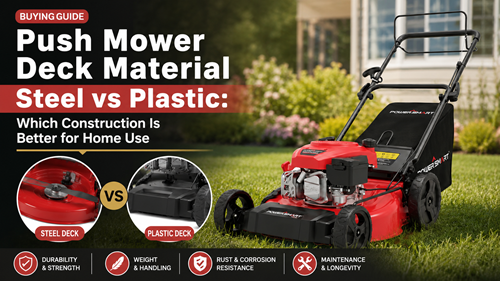
Push Mower Deck Material Steel Vs Plastic is easiest to choose when the mower is matched to the property instead of being judged by power or deck size alone. Deck material affects weight, corrosion behavior, sound, repair options, and how the mower feels when turning. Buyers often simplify the choice into “metal is durable” and “plastic is light,” but modern deck designs use different gauges, ribs, coatings, and structural shapes.
This guide is written for buyers comparing mower construction materials for long-term home use. A push mower deck material steel vs plastic comparison should start with the property. Rocky edges and frequent impacts create different demands from a smooth suburban lawn stored in a dry garage. Coastal humidity changes corrosion concerns, while tight yards make weight more important.
For a push mower deck material steel vs plastic, start by measuring and observing the yard before comparing models. Inspect the underside and mounting points if product photos allow it. Blade clearance, wheel mounts, handle attachment, discharge doors, and access for cleaning all influence service life regardless of shell material.
How To Choose A Push Mower Deck Material Steel Vs Plastic
Steel decks offer rigidity and a familiar durable structure, while molded polymer or composite decks resist rust and can reduce weight. Neither material is automatically superior: impact design, reinforcement, airflow shape, fasteners, corrosion protection, and long-term parts support determine how the complete deck performs.
The right choice should make the normal weekly route easier, not merely win a specification comparison. Think about turning, transport, clipping handling, blade access, and the conditions that occur when the grass is growing fastest.
A useful buying test is to imagine the first ten minutes of mowing and the last ten minutes of cleanup. If the machine fits both parts of that routine, it is much more likely to remain a practical long-term purchase.
Steel, Polymer, Corrosion, And Weight Tradeoffs
Steel Mower Deck Durability
Steel mower decks provide stiffness and can tolerate normal residential use for many years when coatings remain intact and wet clippings are removed. Scratches should not be ignored in corrosive environments.
For a practical comparison, review steel mower deck durability and compare the dimensions or operating limits with your own yard.
Polymer Mower Deck Benefits
Polymer decks cannot rust, can be molded into complex airflow shapes, and often reduce machine weight. Quality depends on material formulation, reinforcement, thickness, and manufacturer testing.
When you narrow the shortlist, compare polymer mower deck benefits against the route, grass condition, and storage limits you measured.
Rust Resistant Mower Housing
Rust resistance involves more than material choice. Steel decks use paint or powder coating, while fasteners, axles, and blade hardware may still corrode if stored wet.
A useful specification check is rust resistant mower housing while confirming that the exact model still matches the manufacturer instructions.
Lightweight Mower Deck
A lightweight deck makes transport and tight turns easier, but total mower weight also includes motor or engine, batteries, wheels, and handle structure.
For this part of the decision, use lightweight mower deck as a reference point rather than assuming one feature guarantees overall performance.
Lawn Mower Deck Construction
Deck construction should be evaluated around wheel mounts, height mechanisms, discharge openings, and blade area. A strong shell with weak attachment points is not a durable system.
Before ordering, cross-check lawn mower deck construction and focus on the specific characteristic discussed here, not the marketing headline alone.
Mower Body Material Comparison
A material comparison should include replacement cost and warranty. Some damage can be repaired on steel; some polymer assemblies are replaced as complete parts.
To connect the feature with a real mower or guide, review mower body material comparison before deciding whether that feature is worth paying for on your property.
Quick Comparison Table
Use this table to turn the topic into a shortlist. The “best” column is not a universal specification; it describes the direction that generally fits the condition in the first column.
| Situation | What to Prioritize | What to Watch |
|---|---|---|
| Steel | Rigid and familiar repair options | Can corrode if coating is damaged |
| Polymer/composite | Rust-proof shell and lower weight | Impact repair may require replacement |
| Coated steel | Good corrosion resistance when maintained | Scratches need attention |
| Any deck | Shape controls airflow and discharge | Material alone does not define cut quality |
| Storage | Dry protected storage extends life | Wet clippings accelerate problems |
A Practical Buying and Mowing Checklist
Use the checklist before purchase and again before the first mowing session. It keeps the decision grounded in yard measurements, safe operation, and maintenance rather than a single headline feature.
- Check total mower weight
- Inspect warranty on deck assembly
- Review storage environment
- Compare underside cleaning access
- Check replacement-part availability
- Look at wheel and handle mounts
- Avoid impact with stones and edging
- Clean and dry after wet mowing
A closely related planning step is covered in mixed-lawn cutting setup, which can help you compare another part of the same mowing workflow without repeating this article’s focus.
Mistakes That Cost Time or Cut Quality
- Assuming all polymer decks are fragile
- Assuming steel cannot rust because it is painted
- Judging deck strength from weight alone
- Ignoring replacement deck and hardware availability
Most of these mistakes come from optimizing one mower specification while ignoring the property. Measure first, use the manual’s operating limits, and make small adjustments after observing the first few mowing sessions.
Safety, Maintenance, and Ownership
Whatever the deck material, routine cleaning and impact inspection matter. Wet clippings hold moisture against hardware, and hidden stone strikes can damage a blade or mounting point even when the shell looks normal.
Before every mow, inspect the area for stones, wire, toys, sticks, holes, people, and pets. Wear appropriate footwear and eye protection, keep guards in place, and never clear a chute or touch the blade area until the mower is fully disabled according to its manual.
For an authoritative safety or turf reference, review CPSC walk-behind mower safety and construction requirements and apply it together with the instructions supplied for the exact mower model.
Final Buying Direction
A push mower deck material steel vs plastic should solve the property-specific problem described in this guide without creating new issues with access, cut quality, maintenance, or storage. The most useful specifications are the ones you can connect directly to a measurement or mowing condition in your own yard.
Shortlist two or three models, compare the complete mower footprint and approved operating features, verify blade and replacement-part support, and choose the machine that makes a safe repeatable weekly routine simplest.
Frequently Asked Questions
Is a steel mower deck more durable than plastic?
Not always. Steel is rigid and repairable in some cases, while engineered polymer can resist rust and impact well. Design quality matters.
Do plastic mower decks crack in cold weather?
Material formulation varies. Follow storage temperature guidance and inspect any deck after a severe impact.
How do I prevent a steel deck from rusting?
Remove wet clippings, keep the mower dry, protect damaged coating when the manufacturer recommends it, and store it properly.
Does deck material affect cut quality?
Deck shape and airflow can affect cut quality, but the shell material by itself does not determine performance.
Which deck is better for a small yard?
A lighter polymer deck can make maneuvering easier, while a steel deck may appeal to buyers prioritizing rigidity. Compare the complete mower, not just the shell.
