
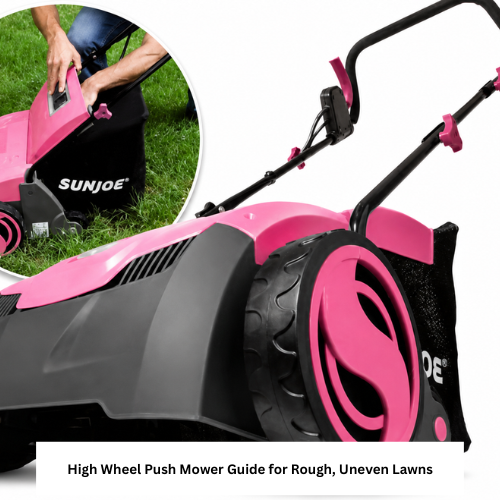
A high wheel push mower uses larger rear wheels than many standard walk-behind models. The larger wheel design may help the machine move across shallow dips, minor bumps, thick turf, and rough lawn sections, but it does not make every slope, rut, or damaged yard safe to mow.
Buyers should compare more than rear-wheel diameter. Machine weight, front-wheel size, wheel tread, deck balance, handle height, drive type, cutting-height controls, and terrain condition all affect maneuverability.
At buy push lawn mower, buyers can compare mower guides, wheel-related products, parts, and accessories while verifying dimensions, compatibility, warranty terms, and replacement availability.
When a High Wheel Push Mower May Help
A large rear wheel mower may be useful when small wheels regularly catch in shallow ruts, thick turf, edging transitions, or mildly uneven areas.
It may provide easier movement across:
- Minor lawn bumps
- Shallow dips
- Thick but maintained grass
- Soft surface transitions
- Uneven garden borders
- Open backyard areas
- Mildly rough terrain
It will not correct:
- Deep holes
- Exposed roots
- Large rocks
- Severe erosion
- Steep slopes
- Muddy ground
- Hidden drainage channels
- Unsafe footing
Review an uneven-terrain mower guide before deciding whether the lawn needs larger wheels, self-propulsion, terrain repairs, or a different type of equipment.
| Mower design | Best suited to | Main advantage | Possible limitation | What to verify |
| High wheel push mower | Mildly uneven lawns | Larger rear wheels may cross small bumps more easily | User supplies all pushing effort | Wheel diameter and machine weight |
| Standard-wheel push model | Smooth, level lawns | Simple and compact | Smaller wheels may catch in ruts | Tread and axle construction |
| Rear-wheel-drive mower | Slopes and traction-focused use | Drive force is applied at the rear | Turning may require practice | Speed control and slope guidance |
| Front-wheel-drive mower | Flat yards with frequent turns | Front can be easier to pivot | Traction may reduce when front lifts | Surface suitability |
| All-wheel-drive mower | Variable terrain | Multiple driven wheels may improve traction | More components and cost | Drive controls and service support |
| Manual reel model | Small, smooth lawns | Quiet and mechanically simple | Limited on rough or tall grass | Ground smoothness and cutting range |
Measure the Wheels and Complete Mower
Do not rely only on phrases such as big wheel or high rear wheel. Compare the documented front- and rear-wheel measurements.
Also measure:
- Total machine width
- Deck width
- Handle width
- Gate openings
- Side-yard clearance
- Storage-door width
- Folded-handle height
- Available floor space
Large wheels may extend beyond parts of the deck. Verify the complete wheel-to-wheel width.
Browse big-wheel push mower options to compare wheel layouts and overall machine designs.
Check Wheel Tread and Construction
Wheel diameter is only one part of rough-lawn handling.
Inspect or verify:
- Tread depth
- Wheel width
- Wheel material
- Axle mounting
- Side-to-side play
- Bearing or bushing design
- Height-adjustment brackets
- Replacement-wheel availability
A narrow smooth wheel may perform differently from a wider wheel with deeper tread, even when both have the same diameter.
A category for push mower wheels can help buyers identify possible replacement products, but every wheel must be matched to the exact mower model.
Do not assume that a universal wheel will fit the axle, gear, bracket, or height-adjustment system.
Setup and Assembly
Inspect the package for damage before assembly.
Follow the instructions to:
- Attach and secure the handle
- Route control cables correctly
- Install the grass bag or chute
- Check wheel fasteners
- Set the initial cutting height
- Add approved fluids when required
- Install the battery or safety key when applicable
- Test control levers
- Roll the mower with the power off
A listed gas mower with high rear wheels can help buyers compare wheel placement and deck layout, but verify the current model specifications and included components.
Do not operate a mower with a wheel that is cracked, loose, misaligned, or rubbing against the deck.
Safety on Slopes and Rough Areas
Follow the manufacturer’s slope instructions and operating pattern. Do not use the machine on terrain that exceeds its documented limits.
Avoid mowing wet slopes. Wet grass and mud can reduce traction for both the operator and the wheels.
Wear closed footwear and maintain stable footing.
Never:
- Reach under the deck
- Pull the mower rapidly toward your feet
- Lift the running mower over a root or curb
- Remove debris while the blade can move
- Use a damaged wheel or axle
- Operate without safety guards
- Leave the mower unattended while running
Complete the shutdown and power-disconnection process before inspection or maintenance.
Cleaning and Maintenance
Follow the shutdown procedure and disconnect the power source before cleaning.
Inspect and clean:
- Wheels
- Axles
- Height-adjustment brackets
- Deck
- Discharge opening
- Grass bag
- Handle joints
- Drive components when applicable
Grass and string wrapped around an axle can restrict wheel movement.
Check wheel fasteners regularly. Do not overtighten components that need to rotate.
Replace cracked wheels, worn tread, bent axles, damaged adjusters, and loose brackets with compatible parts.
Browse lawn mower parts and accessories when researching replacement wheels, blades, bags, covers, fasteners, and maintenance products.
Store the mower clean and dry. Fold the handle only according to the manual so control cables are not pinched.
The AMERISUN high-wheel mower listing can help buyers compare wheel placement, handle layout, and product information, but verify the current model, seller, specifications, and included parts before ordering.
Conclusion
A high wheel push mower may improve movement across mildly rough or uneven grass, but wheel diameter should be considered with machine weight, front-wheel design, deck stability, tread, handle position, and terrain safety. Measure the property, repair dangerous areas, and verify parts and service support before buying.
FAQ
Are larger rear wheels better for uneven lawns?
They may move across minor bumps more easily, but overall handling also depends on the front wheels, weight, deck, and terrain.
Is a high-wheel model safe on steep slopes?
Only when the slope is within the manufacturer’s documented operating limits. Larger wheels do not make every incline safe.
Do large wheels make turning easier?
They may help in some conditions, but deck balance, bag weight, drive system, and handle design also matter.
Should I choose push or self-propelled?
A manual-push model may suit a small, gentle lawn. Self-propulsion may help on larger yards, heavier machines, or long inclines.
Can mower wheels be replaced?
Many can, but the diameter, axle, gears, bracket, and mounting design must match the exact model.
