
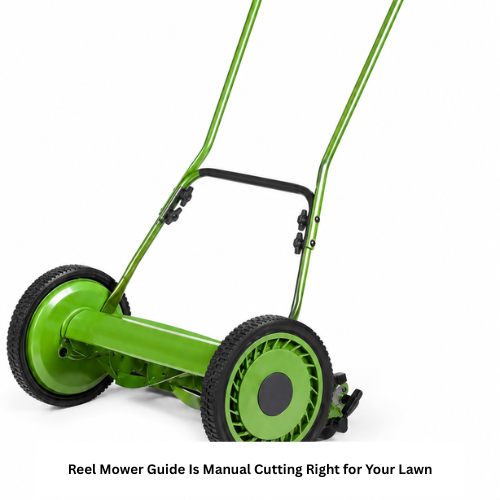
A reel mower uses a rotating cylinder of blades and the user’s forward movement to cut grass without a gas engine, battery, or power cord. It can be a practical choice for a small, regularly maintained lawn, but it may become difficult to use on tall, thick, wet, or uneven grass.
Before buying, consider the lawn size, grass type, mowing frequency, terrain, storage space, and physical effort required. buy push lawn mower shoppers should also verify the cutting-width range, height settings, handle design, grass-catcher compatibility, warranty, and replacement-part availability.
When a Reel Mower Is a Good Choice
A manual machine works best when the lawn is relatively level and mowing is done before the grass becomes overgrown.
It may suit homeowners who want:
- A quiet lawn mower
- A lawn mower without engine maintenance
- An eco friendly mower for routine yard care
- A compact machine for a small lawn
- No fuel, charging, or extension-cord setup
- Simple seasonal storage
- A mower that starts whenever it is pushed
A push reel mower still requires regular blade care and physical effort. It should not be treated as a maintenance-free tool.
A practical manual lawn mower beginner guide can help first-time buyers understand setup, cutting technique, and blade adjustment before choosing a machine.
| Lawn condition or buyer need | Manual mower suitability | Main advantage | Possible limitation | What to verify |
| Small, level lawn | Strong match | Quiet and simple operation | Requires frequent mowing | Cutting width and height range |
| Narrow pathways | Often suitable | Compact turning area | Wide wheels may not fit | Complete wheel-to-wheel width |
| Thick or tall grass | Limited | Can work with repeated light passes | May jam or miss grass | Supported grass type and growth height |
| Uneven lawn | Depends on severity | No powered drive system to maintain | Wheels may lose ground contact | Wheel size and terrain guidance |
| Limited storage | Often suitable | No fuel or battery storage | Handle may not fold | Folded or stored dimensions |
| Physical effort concerns | Depends on user | Lightweight models may help | User provides all forward power | Weight, handle height, and blade adjustment |
Measure the Lawn and Access Points
Begin by estimating the mowing area. A manual design is usually easier to manage on a compact yard that can be cut regularly.
Measure:
- The narrowest gate
- Walkways between garden beds
- Space around trees
- Shed or garage door width
- Available storage depth
- Storage height
- Distance from storage to the lawn
The advertised cutting width does not include the complete width of the wheels and frame. Verify the fully assembled dimensions before buying.
The small-yard mower guide can help homeowners compare cutting widths, maneuverability, and storage needs for compact properties.
Check Cutting-Height Adjustments
Grass varieties have different preferred cutting heights. Verify that the machine’s available settings match the grass on your property.
Check whether height adjustment:
- Uses levers or bolts
- Requires tools
- Changes both sides together
- Has clear position markings
- Locks securely
- Keeps the cutting cylinder aligned
Do not assume that every manual mower is suitable for very low cutting. Cutting too low can increase pushing resistance and expose high areas of uneven ground.
Grass Catcher Compatibility
A grass catcher can reduce loose clippings on paths, patios, and garden borders. However, not every catcher fits every manual mower.
Review a reel mower grass catcher guide before choosing an attachment.
Confirm:
- Exact mower model compatibility
- Catcher width
- Mounting brackets
- Ground clearance
- Capacity
- Replacement hooks or clips
- Whether the catcher affects turning
A catcher adds weight as it fills. Empty it before the extra load makes the mower difficult to control.
Assembly and First Setup
Inspect the shipping carton before opening it. Photograph damage and check the parts list before discarding packaging.
Assembly may involve:
- Joining handle sections
- Installing knobs and bolts
- Attaching the handle to the frame
- Setting the initial cutting height
- Installing a catcher bracket
- Checking wheel movement
Use only the supplied or manufacturer-approved hardware. Do not force handle sections or substitute bolts that may interfere with moving parts.
Before using the reel mower, push it slowly over a clear section of lawn and listen for binding, heavy scraping, or loose components.
Check Blade Alignment Safely
The rotating cylinder and stationary cutting edge must be adjusted correctly. Excessive contact can increase resistance and wear, while too much clearance may leave grass uncut.
Follow the paper-cut or alignment test in the manual. Never place fingers between the blades.
Before adjusting:
- Stabilize the machine.
- Wear suitable gloves.
- Keep hands outside the blade path.
- Use the approved adjustment points.
- Turn the cylinder only as instructed.
The mower blade sharpener guide can help buyers understand available sharpening tools, but verify compatibility with the exact blade system.
Seek professional servicing if the cylinder is bent, chipped, or impossible to align.
Cleaning, Maintenance, and Storage
Brush away dry clippings after each use. Use water only when the manual permits it, and dry all metal parts before storage.
Inspect:
- Cutting blades
- Stationary cutting edge
- Wheels and axles
- Handle fasteners
- Height-adjustment parts
- Grass-catcher brackets
Lubricate only the points specified by the manufacturer.
Store the machine in a dry area where the blades cannot be reached accidentally. Avoid placing heavy tools against the handle or cylinder.
The American Lawn Mower Company 1815-18 listing can be used to compare handle design, wheel layout, and package details, but verify the current specifications and seller before ordering.
Conclusion
A reel mower can be a practical option for a small, smooth lawn that is cut frequently. It provides quiet manual operation without fuel or battery care, but it requires correct adjustment, regular mowing, and safe blade maintenance. Compare the yard conditions, cutting width, height range, physical effort, parts, and support before choosing one.
FAQ
Can a manual mower cut tall grass?
It may struggle with tall or dense growth. Reduce overgrown grass with an appropriate method before beginning a regular manual mowing schedule.
Is a manual mower difficult to push?
Effort depends on grass height, blade alignment, cutting height, machine weight, wheel condition, and terrain.
How often do the blades need sharpening?
There is no single schedule for every model. Sharpen or service them when adjustment no longer produces a clean cut.
Can I use a manual mower on uneven ground?
Minor irregularities may be manageable, but deep holes, roots, and rough terrain can cause an uneven cut.
Is a grass catcher necessary?
No. It is optional, but it can help keep clippings away from paths and garden beds.
