
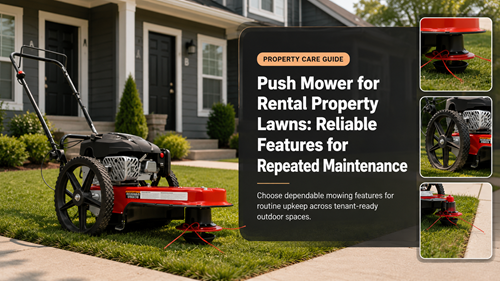
Push Mower For Rental Property Lawns is easiest to choose when the mower is matched to the property instead of being judged by power or deck size alone. Landlords and property managers often mow on a schedule dictated by tenant turnover, inspections, or service routes rather than ideal turf timing. A machine that tolerates regular use and is easy to inspect between properties can be more valuable than a feature-heavy consumer model.
This guide is written for landlords and property managers maintaining residential lawns. A push mower for rental property lawns should match the largest and most difficult property in the regular route without being oversized for every other yard. Storage in a trailer, garage, or maintenance room also needs to be considered.
For a push mower for rental property lawns, start by measuring and observing the yard before comparing models. Create a small maintenance log for blade service, air filters or batteries, wheel hardware, and damage. Repeatable checks reduce the chance that a minor problem follows the mower from one property to the next.
How To Choose A Push Mower For Rental Property Lawns
A rental-property mower should prioritize predictable starting, durable wheels and deck, readily available blades and wear parts, simple maintenance, and enough capacity to handle several lawns without becoming a repair project. Standardized controls and easy transport are valuable when more than one person may use it.
The right choice should make the normal weekly route easier, not merely win a specification comparison. Think about turning, transport, clipping handling, blade access, and the conditions that occur when the grass is growing fastest.
A useful buying test is to imagine the first ten minutes of mowing and the last ten minutes of cleanup. If the machine fits both parts of that routine, it is much more likely to remain a practical long-term purchase.
Durability And Service Features For Repeated Property Work
Durable Mower For Landlords
Landlord use favors a robust deck, secure handle joints, replaceable wheels, and controls that do not feel fragile. Durability still depends on avoiding impacts and keeping the deck clean.
For a practical comparison, review durable mower for landlords and compare the dimensions or operating limits with your own yard.
Low Maintenance Lawn Equipment
Low-maintenance equipment can simplify a multi-property schedule. Cordless systems reduce fuel handling, while gas engines can offer fast refueling; choose the workflow your storage and route support.
When you narrow the shortlist, compare low maintenance lawn equipment against the route, grass condition, and storage limits you measured.
Mower For Multiple Properties
A mower used at several addresses needs sufficient runtime or fuel capacity. Transport position, tie-down points, and whether fluids can leak during movement matter as much as mowing speed.
A useful specification check is mower for multiple properties while confirming that the exact model still matches the manufacturer instructions.
Rental Home Yard Care
Rental home care benefits from one consistent cut-height policy. Record the preferred setting for each turf type instead of letting every visit begin with guesswork.
For this part of the decision, use rental home yard care as a reference point rather than assuming one feature guarantees overall performance.
Dependable Residential Mower
A dependable residential mower should have blades, wheels, bags, and common service parts available without a long special-order delay. Check model support before standardizing a fleet.
Before ordering, cross-check dependable residential mower and focus on the specific characteristic discussed here, not the marketing headline alone.
Property Maintenance Mowing Tools
Property-maintenance tools should travel as a small system: mower, trimmer, PPE, hand tools, cleaning brush, spare blade or battery, and a way to secure everything during transport.
To connect the feature with a real mower or guide, review property maintenance mowing tools before deciding whether that feature is worth paying for on your property.
Quick Comparison Table
Use this table to turn the topic into a shortlist. The “best” column is not a universal specification; it describes the direction that generally fits the condition in the first column.
| Situation | What to Prioritize | What to Watch |
|---|---|---|
| One small rental | Simple reliable push mower | Prioritize low ownership complexity |
| Several lawns | Runtime and transport matter | Standardize service parts |
| Mixed turf types | Wide height range | Record property settings |
| Frequent bagging | Durable bag frame | Inspect seams and chute |
| Shared operators | Simple controls | Keep manual and safety rules accessible |
A Practical Buying and Mowing Checklist
Use the checklist before purchase and again before the first mowing session. It keeps the decision grounded in yard measurements, safe operation, and maintenance rather than a single headline feature.
- List all property lawn sizes
- Identify the hardest property
- Choose a repeatable power platform
- Verify parts availability
- Create a maintenance log
- Inspect blade before each route
- Secure mower during transport
- Clean debris before storage
A closely related planning step is covered in compact mower storage planning, which can help you compare another part of the same mowing workflow without repeating this article’s focus.
Mistakes That Cost Time or Cut Quality
- Buying separate incompatible battery platforms
- Skipping blade service because the mower still starts
- Transporting a gas mower in an unsafe orientation
- Choosing fragile convenience features for repeated use
Most of these mistakes come from optimizing one mower specification while ignoring the property. Measure first, use the manual’s operating limits, and make small adjustments after observing the first few mowing sessions.
Safety, Maintenance, and Ownership
Routine ownership still matters after the purchase. Keep the blade sharp, clean the deck with the power source disabled, inspect wheels and fasteners, and follow the manual for battery, cord, fuel, oil, and seasonal storage requirements.
Before every mow, inspect the area for stones, wire, toys, sticks, holes, people, and pets. Wear appropriate footwear and eye protection, keep guards in place, and never clear a chute or touch the blade area until the mower is fully disabled according to its manual.
For an authoritative safety or turf reference, review CPSC walk-behind mower safety guidance and apply it together with the instructions supplied for the exact mower model.
Final Buying Direction
A push mower for rental property lawns should solve the property-specific problem described in this guide without creating new issues with access, cut quality, maintenance, or storage. The most useful specifications are the ones you can connect directly to a measurement or mowing condition in your own yard.
Shortlist two or three models, compare the complete mower footprint and approved operating features, verify blade and replacement-part support, and choose the machine that makes a safe repeatable weekly routine simplest.
Frequently Asked Questions
Is gas or battery better for rental properties?
Either can work. Gas allows fast refueling; battery reduces engine maintenance and fuel storage. Route size and charging access should decide.
How often should a property mower blade be checked?
Inspect it frequently and after impacts. Sharpen or replace based on cut quality, damage, and manufacturer guidance.
Should landlords buy self-propelled mowers?
They can reduce fatigue on larger or sloped properties, but add drive-system parts that also need service.
What makes a mower easier to transport?
Moderate weight, folding handles, secure tie-down options, and a design that can be transported in an approved orientation.
How can I keep cuts consistent across rentals?
Record preferred height settings, standardize mower setup, and maintain blades so different properties receive predictable results.
